

Harnessing the Power of Entrepreneurship
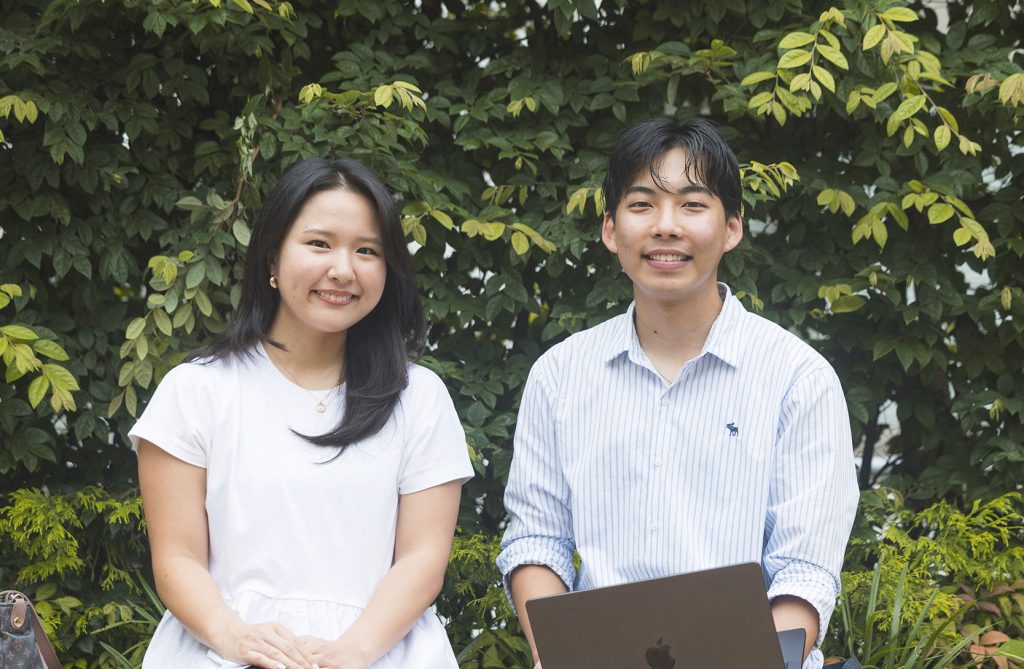
Eri Terada
4th-year student, Department of Global Studies, Faculty of Global Studies
Kaiei Maesaka
4th-year student, Department of International Legal Studies, Faculty of Law


CROSS TALK
Connecting People Across Different Backgrounds, Inspiring New Insights
This session features two Sophia students who have studied entrepreneurship, the mindset and actions of a challenger as defined by the Sophia Entrepreneurship Network (SEN). While one student has chosen to start a business, the other has decided to join a startup. Here, they share their experiences of learning and taking on challenges at Sophia.
What We’ve Learned at Sophia
In my third year, I was part of a research seminar where we took a practical approach to studying arbitration and negotiation in the context of international business issues. After studying negotiation theory, international business law, and dispute resolution, I took part in the Intercollegiate Negotiation Competition in the fall. In this international competition, university teams compete through simulations of dispute resolution and consensus building. Twenty-seven universities from across the world took part, spending two days debating before a panel of practitioners and researchers. We had a strong showing, placing first among the Japanese universities and third overall. Engaging in timely discussions with students from around the world about the use of AI in healthcare served as the catalyst for my current career in AI.
I also feel strongly that what I learned at Sophia has shaped what I do today. At the Faculty of Global Studies, we take a broad, global view through international relations while also examining issues from the ground up through area studies. This combination allows us to see global issues from multiple angles. I chose Civil Society and International Cooperation as my major and Middle-Eastern and African Studies as my minor. In international cooperation, as I learned about the frameworks of international development assistance, I also came to see that providing funds or supplies doesn’t necessarily solve the problems at hand. This led me to believe that, rather than providing temporary aid, it’s important to build locally rooted systems that enable people to earn their own income. Through African studies, I also learned to look beyond Africa as a whole and pay close attention to the historical, cultural, political, and economic differences among its countries and regions.
Learning Entrepreneurship to Expand Options
From the moment I started at Sophia, I wanted to contribute to solving social issues in Africa. So I took part in on-campus events like United Nations Weeks and Africa Weeks, exploring ways to engage with Africa while gaining new perspectives. Around the same time, the region was experiencing what is known as “leapfrog” development where mobile payment services spread rapidly even before landline phones became widespread. When I learned that local startups and entrepreneurs were driving this development, I began to see starting a business as one way to make a difference.
Same here. I saw starting a business as one way to turn ideas into reality. I experienced this firsthand through one of the most memorable learning opportunities I had at Sophia, the Entrepreneurship Course which is offered in cooperation with SPARX Group, an investment management company. I learned the basics of launching a business, developed a business proposal, and even had the opportunity to secure funding and put my ideas into action. Along the way, I discovered Lovable, a development tool from Europe, and became its ambassador, contributing to the democratization of software development. Building prototypes led me to start several projects that used AI to solve questions that popped into my head. Looking back, taking action while embracing unexpected encounters and opportunities has led me to take on new challenges. In that sense, my experiences could be seen as an example of putting the planned happenstance theory into practice.
Bringing New Value from Ghana to Global Markets
As I explored ways to address social issues in Africa, I gradually became interested in business and creating new businesses as one way to make a difference. I took part in business competitions overseas and interned at the Japan International Cooperation Agency in a department that supports startups in Africa, where I learned how business can be used to address social issues. I then studied at the University of Washington (UW) in the U.S. and joined a 10-month program focused on starting a business. There, a friend from Ghana told me about cashew apples, which are discarded in large quantities during the cashew nut harvest. Having learned about their potential at UW, I went straight to Ghana to see the situation for myself before returning to Japan. Having interviewed 100 farmers about their income structures and the challenges they faced, I found that many relied solely on income from the nuts. Some even asked me to buy their cashew apples and build a factory to process them. I saw the potential for turning this into a business that could not only help reduce food loss but also create new sources of income and employment. Back in Japan, I developed sample products and held tasting sessions before establishing POT3NTIA. LLC in April 2026. We are now preparing for test sales in Ghana to explore the potential for selling our products in the local market.
What It Takes to Make It in the World of International Business
This year, I joined an AI startup in San Francisco, the center of the AI ecosystem, as a full-time employee. Working in a small team and taking on a wide range of responsibilities, I’ve had opportunities to work with AI companies like Google, OpenAI, and Anthropic, as well as government agencies and experts and professionals from a variety of fields. Working in a fast-changing environment, every day is packed with opportunities to gain new knowledge and perspectives. I’m currently leading projects in parallel, with each of the three founders overseeing a different project. The expectations are extremely high, and although I’m often overwhelmed by their knowledge and abilities, I’m taking everything I can from the experience. One thing that has really struck me since joining the company is that, at the world’s highest levels of professional work, age and other factors beyond our control are rarely decisive barriers. What matters is simply whether you can do the job, and just as important is whether you can build trust and strong relationships with the people you work with. I now know from experience that neither of these qualities is something we’re born with; both can be honed through our own efforts.
Family, the Greatest Source of Support
Because my two older sisters had both spent time abroad, my family never opposed my decision to study abroad or start a business. Still, starting a business is not your typical career path, so it was natural for my family to be concerned. Even so, I believe that the experiences of tackling real-world challenges, coming up with my own questions, learning what I need to know, and turning ideas into reality with the support of those around me will all serve me well, whatever path I choose in the future. That’s why, for now, I want to give my all to the things I truly want to pursue.
My experience was a little different. My parents were somewhat reluctant, but beneath their concerns was a desire for me to make the best choice for myself. Their worries come from the uncertainty of what lies ahead. That’s why I believe that if you choose a less conventional path, it’s important to have a clear vision of where you want to make a difference and to approach the path you’ve chosen with sincerity and commitment. At times, what’s right for you may not be playing it safe, even though that’s what conventional wisdom would suggest. I have a great deal of respect for my parents for being willing to say difficult things to me when I was making decisions about my career.

Shaping the Future Through Entrepreneurship Fostered at Sophia
Before studying abroad, I had to find information about starting a business on my own. But when I returned to Japan, SEN had been launched. With a wide range of programs, including opportunities to learn directly from impact investors and to connect with other students interested in starting a business, SEN offers an environment where students can explore the issues they care about and take on new challenges. What makes the program distinctly Sophia, I think, is that it goes beyond simply teaching students how to build a business. Instead, it gives us the opportunity to think together about what kind of businesses can address different social issues. My ambitious dream is to bring the untapped potential of Africa’s resources, culture, and people to the wider world in ways that support local sustainability and foster a sense of pride.
To me, entrepreneurship means accurately assessing the current situation, clearly identifying the gap between where we are and where we want to be, and building solutions to bridge that gap. I believe the most important skill in this process is the ability to listen. In a world where divisions are deepening and misunderstandings are spreading, the key is to reexamine the issues we face with a genuine curiosity about others and to return to first principles. As it becomes harder to rely on past precedents, we will be expected to embrace uncertainty and take action.
-
Eri Terada
- 4th-year student, Department of Global Studies, Faculty of Global Studies
-
A volunteer experience in high school sparked her interest in social issues in Africa. To create new industries and jobs in Ghana, she launched a business developing and selling new products made from locally grown agricultural products, and established a company in 2026.


-
Kaiei Maesaka
- 4th-year student, Department of International Legal Studies, Faculty of Law
-
He spent his early childhood abroad. Combining diplomacy and entrepreneurship, he has gained knowledge and built experience in Japan and overseas. Through connections made in Sophia’s Entrepreneurship Course, he has joined a San Francisco-based startup driving the AI ecosystem.
Published in Sophialogue Vol. 1 (Autumn/Winter 2026), p.2–5
※Please note that the information in this article is current as of November 2026.


