

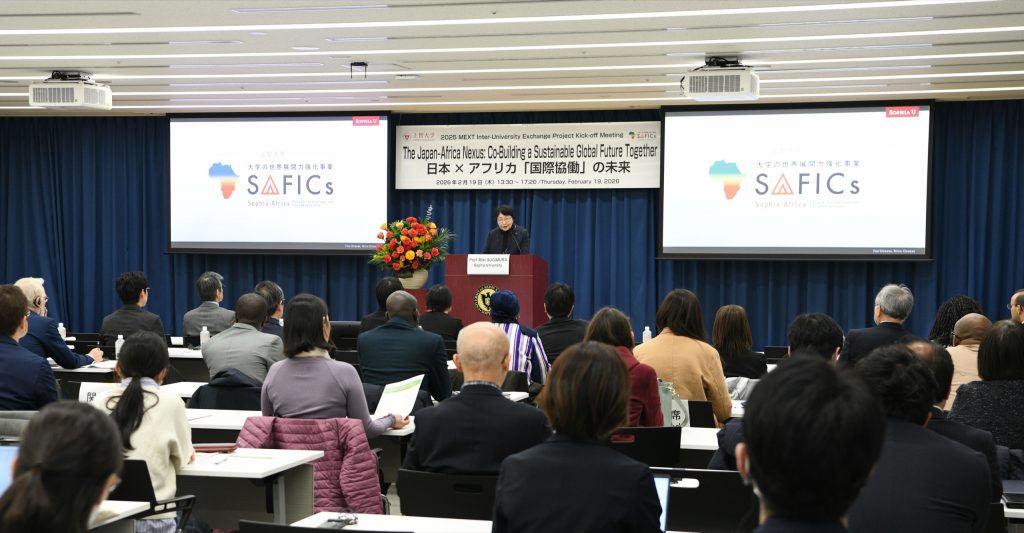


Window to the World
Sophia University’s Program for Developing Leaders Who Contribute to Solving Global Environmental Challenges through International Collaboration has been selected for Type II: African Countries under the Ministry of Education, Culture, Sports, Science and Technology’s FY2025 Inter-University Exchange Project–Support for the Formation of Inter-University Exchanges with Global South Countries.
Program Overview
Through international collaboration between Japan and African nations, this program cultivates next-generation leaders capable of tackling global environmental challenges. It consists of three components—lectures, short-term training, and practical international collaborative training—that deepen learning from both theoretical and practical perspectives.
Joint Study Courses (Lectures)
Students from Japan and Africa study the history, culture, economics, and other aspects of both regions in lecture courses that use Collaborative Online International Learning (COIL). They then acquire the expertise to explore shared challenges through Japan-Africa Studies, International Cooperation Studies, and Global Environmental Studies.
Short-Term Training
Students take part in the short-term programs Learn from Africa (Outbound Program) and Summer Session (Inbound Program), putting into practice what they have learned in the joint study courses. Through exchanges with local students and fieldwork, they deepen their understanding of the global challenges Japan and Africa share.
International Collaborative Practical Training and Mid- to Long-Term Study Abroad
Students take part in the Human-Nature Coexistence Project and the SADO Project on environmental conservation in Japan, in volunteer work and internships with international organizations, and in exchange programs. Across local communities, private companies, and international organizations, they identify shared challenges and seek solutions through international collaboration.
Certificate of Program Completion
Students who complete the program through the curriculum described above and achieve the required academic performance will receive an open badge, a digital certificate of completion, for the Sophia-Africa Future Initiatives for Collaborations.
Partner Universities
 Stellenbosch University
(South Africa)Website
 Egypt-Japan University of Science and Technology (E-JUST)
(Egypt)Official Website
 Jesuit University of Abidjan
(Côte d’Ivoire〈Ivory Coast〉)Official Website
 Félix Houphouët-Boigny University
(Côte d’Ivoire〈Ivory Coast〉)Official Website
 Arrupe Jesuit University
(Zimbabwe)Official Website
 University Cheikh Anta Diop (UCAD)
(Senegal)Official Website
 University of Ghana
(Ghana)Official Website
Outbound and Training Programs Tackling Global Environmental Challenges with Partners in Africa
Learn from Africa (Outbound Program)
This program aims to move beyond fixed images of Africa and to understand societies that are changing rapidly. Students travel to an African country to gain a deep understanding of the issues it faces and their historical background. The program also places great importance on dialogue with the people students meet locally and on mutual learning among participants, helping each student deepen their own learning. Destinations vary from year to year. In FY2026, students will travel to Côte d’Ivoire in summer and South Africa in spring.
International Collaborative Volunteer
In collaboration with the Japan International Cooperation Agency (JICA), students engage in volunteering at the Japan Corner of Félix Houphouët-Boigny University in Abidjan, Côte d’Ivoire, one of our partner institutions, as JICA’s Japan Overseas Cooperation Volunteers. Working alongside the university’s faculty, staff, and students, as well as Japanese-language teachers dispatched by private foundations in Japan, they provide volunteer support for Japanese-language education and teaching-material development, as well as the planning and operation of events showcasing Japanese culture.
SADO Project
— Sustainability Study on SADO Island —
Set on Sado Island, home to the UNESCO World Heritage Site Sado Island Gold Mines and rich natural surroundings, this field-based program lets students learn about sustainable societies. Through fieldwork and exchanges with local residents, they explore themes such as environmentally friendly farming, ecosystem conservation, traditional culture, and ecotourism. Japanese and African students learn side by side and make proposals to the local community, building a holistic view of environmental, social, and cultural issues and the practical skills to help create a sustainable future.
Voices
How Local Voices and Cross-Cultural Interaction Broadened My Perspective
2nd-year student, Department of German Studies, Faculty of Foreign Studies
Shinichiro Karino
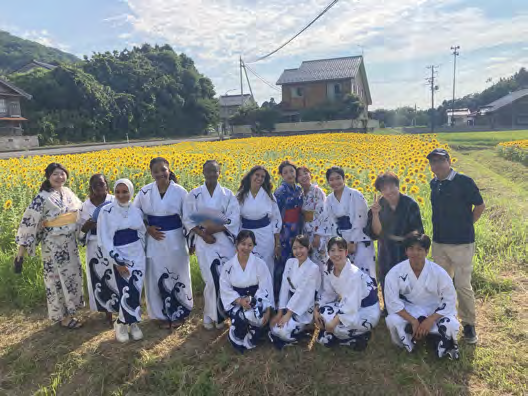
On the SADO Project, interviewing local residents showed me what life in the community is really like — things I could not have learned online or from written materials. I was especially struck by hearing from local government officials, people in agriculture and fisheries, and high school students about issues such as population decline.
Working alongside students from Africa, I realized that even when we look at the same community or issues, our views differ with the environments and cultures we grew up in. My language skills sometimes frustrated me, but I learned how important it is to speak up and try to understand others.


Published in Sophialogue Vol. 1 (Autumn/Winter 2026), p.24-25
※Please note that the information in this article is current as of November 2026.


