

Combining What You Learn Makes Learning Even More Interesting

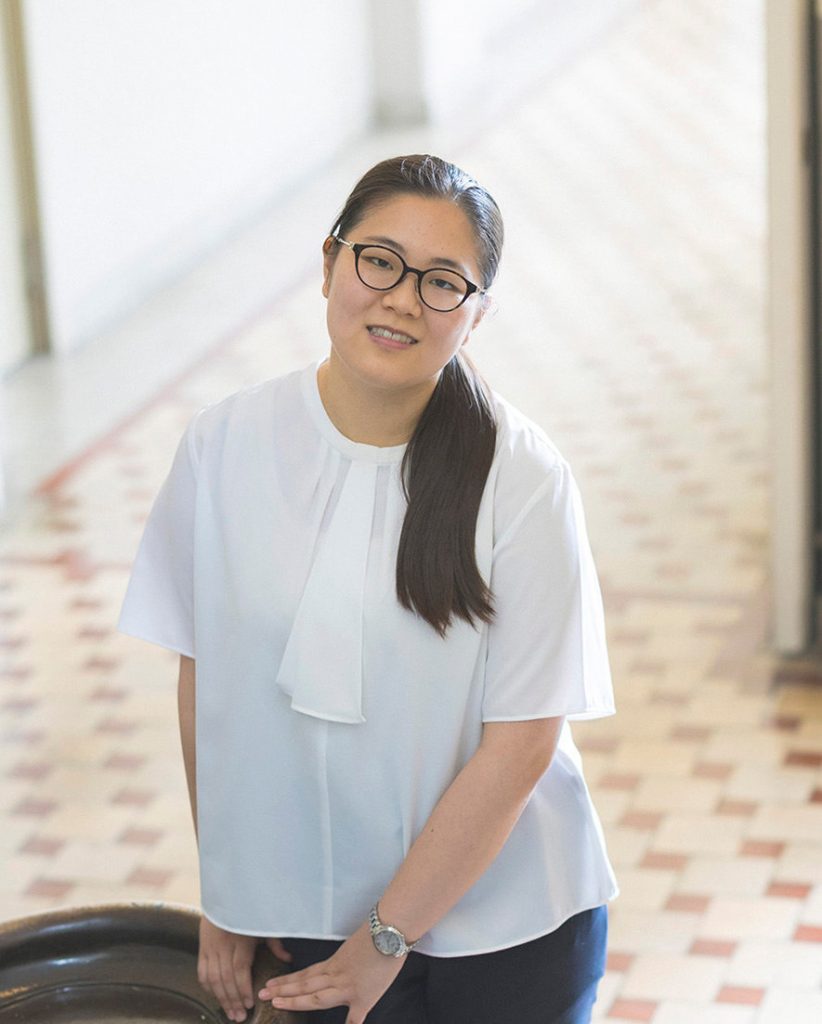
Chisaki Aoyagi
4th-year student, Department of Hispanic Studies, Faculty of Foreign Studies


LEARNING YOUR WAY
Chisaki Aoyagi, a student in the Department of Hispanic Studies, has broadened her interests through study abroad, campus events, and courses beyond her department.
I first heard Spanish in the U.S., where I spent my early childhood, and was struck by how different it sounded from Japanese. I remember thinking, “There’s a language like this in the world? How cool!” Studying it in high school as my second foreign language deepened that interest, and I began hoping to study abroad. I chose Sophia for its Spanish specialization and its many partner universities in Spain.
To see if I was ready for a long-term program, I joined a short-term training program in Spain during the spring break of my first year, taking classes in grammar, communication, and culture, all in Spanish. It was exciting to see my classroom learning come alive in real conversation. At the same time, I was frustrated that I could understand what people said but struggled to respond in my own words. Back in Japan, I made the most of the Language Learning Commons (LLC), which offers free language support, and took lessons from a senior student who had studied in Uruguay.
Then came my year-long exchange at the University of Deusto in Bilbao, where I had done my short-term training, drawn by the feel of the city and the warmth of its people. Alongside linguistics, I took courses in sociology, Spanish literature, and Basque, and threw myself into extracurricular activities I never had time for before. Discovering Basque dance deepened my appreciation of the culture and brought me closer to local people. Someone I met there later gave me the chance to help with a film production back in Japan. The year improved my Spanish and gave me an understanding of daily life in Spain that only living there could.
Studying abroad was not my only way of exploring: whenever something caught my interest, I looked beyond my department. One example was Introduction to Language Information Modeling, offered by the Faculty of Science and Technology, which gave me a new way of looking at language. I also discovered phonetics in a team-taught course open to all faculties, and hearing from specialists in different fields broadened my interests. I’m now writing my graduation thesis on a related topic.
Outside the classroom, I’ve organized events for Africa Weeks, taken part in the Bookstore Fair Contest, where students plan ways to share what’s great about books at the campus bookstore, and served as a campus tour guide.
To broaden my learning, I make a point of keeping up with what’s happening on campus. I regularly check the My Sophia portal and the university website, where articles on faculty research, event listings, and updates from Sophia Student Integration Commons (SSIC) have led me to new interests. With every faculty on one campus in Yotsuya, there are so many chances to follow your curiosity and take on something new.
Lately I’ve been interested in the Sophia-Africa Future Initiatives for Collaborations (SAFICs), a new program that explores international cooperation and global challenges through collaboration with Africa. I’d love to join if I get the chance.
-
Chisaki Aoyagi
- 4th-year student, Department of Hispanic Studies, Faculty of Foreign Studies
-
Drawn to Spanish from an early age, she chose Sophia to pursue her passion for the language. Alongside a short-term training program and a year-long exchange, she has taken part in numerous events on campus, an internship at the Embassy of Burkina Faso in Japan, and a Bibliobattle, a book review competition. She is now writing her graduation thesis on Basque from a phonetic perspective.


Published in Sophialogue Vol. 1 (Autumn/Winter 2026), p.10–11
※Please note that the information in this article is current as of November 2026.


