

Department of Engineering and Applied Sciences
Department Features
New technologies that transcend the boundaries of disciplines such as mechanical engineering, electrical and electronic engineering, physics, chemistry, mathematics, and information are emerging one after another. In such an age, the ability to achieve unprecedented approaches based on cross-disciplinary knowledge through the fusion of science and engineering is required so as to maximize the functions of goods and systems and to solve problems as they arise. The Department of Engineering and Applied Sciences explores creation—including the creation of new functions based on the new discovery of physical phenomena and their possible applications to support humans and the environment—as its foundation. Through integrated studies of science such as physics and mathematics, and engineering such as materials, electronics, energy, and mechanical systems, the department fosters talented individuals capable of achieving harmony between industrial technology and natural science.
Research Examples
・Unique Research on a Magnetic Suspension System, Patented During School Years
The vehicle can remain afloat without falling when a bulk superconductor that does not pass magnetic field lines is placed between electromagnets on the ceiling and the iron rails of the track. Many students have conducted research based on this principle with its original ideas, and some of them have obtained patents while still at school.
・Applying Mechanical Engineering to Medicine to Reduce the Risk of Brain Injury
Using numeric analysis based on physics and mathematics, we can predict the site and degree of the damage by calculating the movement and deformation of a body during an accident. The program provides not only knowledge on mechanical engineering but also on a wide range of other fields including medicine.
・Toward the Elucidation of Cosmic Primordial Substances
Using knowledge of physics, we explore the behavior of the substances that filled the universe immediately after the Big Bang. Students learn numerical calculation techniques as they simulate trillions of substances on computer in experiments.
Curriculum
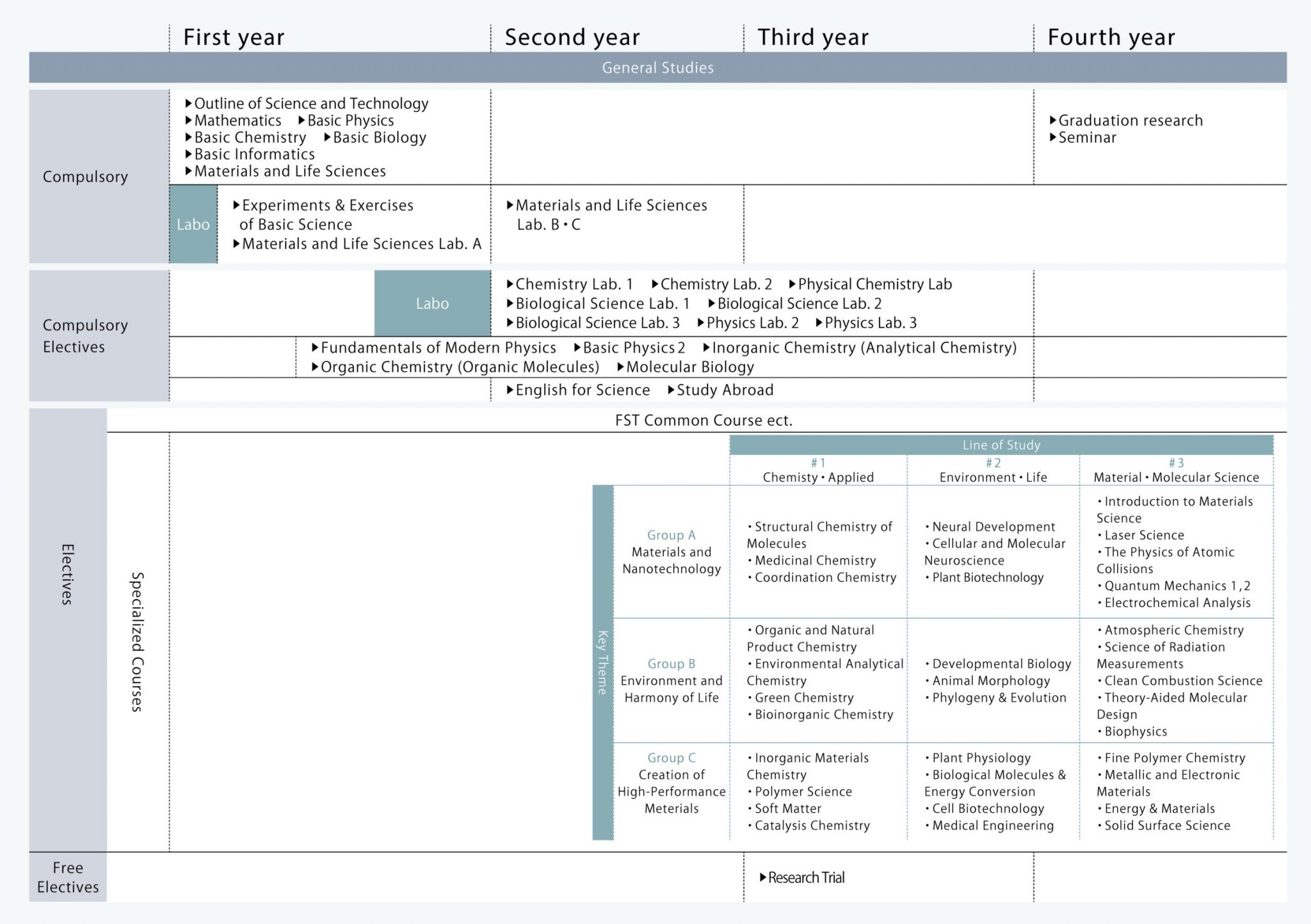
After completing the general studies on basic science and technology in the first year, second-year students begin conducting experiments and studying courses from the Faculty of Science and Technology Common Subject Group related to their specialties such as physics, mechanical engineering, and electrical/electronic engineering. During the second semester of their second year, students will choose the specialties from three courses, Mechanical Engineering, Electrical and Electronic Engineering, and Physics, based on the academic system (1–3). Students can also expand their interests and expertise from three themes (Group A–C): Creation and Use of Energy, Understanding Matter and Creating Materials and Devices, and Creating Manufacturing Systems. In their third year, students will study specialized education along with advanced exercises and experiments, and those who wish can take Research Trial to experience research activities one year earlier. In the fourth year, students will conduct graduation research on their own themes.
as of 2026
*For further information on the courses, please refer to the Syllabus.
Course Examples
- Thermal Energy Conversion
Students will gain understanding of the performance and characteristics of engines, gas turbines, compressors, etc. as well as the process of thermal energy conversion into power and the parameters on energy efficiency.
- Electric Power System Engineering
This course covers systems consisting of power plants, transmission facilities, substations, distribution facilities, and consumers, and teaches the concepts of control, economy, and reliability for the stable use of electric energy.
- Low-temperature and Superconducting Materials
Students will learn the fundamentals of low-temperature physics and deepen their understanding of transport phenomena and superconductivity under low-temperature environments. Students will also acquire knowledge of superconducting materials and engineering applications for next-generation energy.
- Robotic Systems
The course provides basic knowledge on the analysis and suppression of robot motion, especially robot kinematics and trajectory planning, and robot attitude control and trajectory tracking control.
- Optoelectronics
Optoelectronics, such as LEDs and solar cells, are now indispensable technologies for society. In the lectures, students will learn about the system structure and operating principles, as well as the physical phenomena of optical devices and their component technologies, and their social roles.
- Introduction to Materials Science
Students learn the fundamentals of electronic devices and material properties by focusing on phenomena caused by the macroscopic number of individual atoms and molecules that make up matter.
Available Teaching Licenses and Subjects
- First Category Teaching license for Junior High School (Mathematics, Science)
- First Category Teaching license for High School (Mathematics, Science, Industry)
Qualifications
- Chief Electrical Engineer
- On-the-Ground Category-I Special Radio Operator
- Maritime Category-III Special Radio Operator
- Eligibility Requirements for Hazardous Material Handler (Type I)
Curatorial Courses are also available.
Educational Objectives and Policies
-
To foster students’ ability to create entirely new values and functions by acquiring knowledge of materials, devices, energy, machinery, and systems, through an in-depth understanding of physics and mathematics.
-
To nurture human resource who can, with a flexible mindset, apply and develop a wide range of knowledge and solid expertise acquired, so that they can contribute to solving various scientific and technological problems.
-
The Department of Engineering and Applied Sciences, aims to foster human resources with solid fundamental knowledge of science and technology who can contribute to the acquisition of new physical values and the development of ingenious technologies. With a view to this aim, the department sets standards for the skills and knowledge students should acquire before graduation as described below. Those who have fulfilled the requirements and have passed the thesis defense will be awarded a diploma.
- The broad ability to address science and technology issues, acquired by studying the fundamentals of science and technology, including natural science disciplines.
- The ability to contribute to the acquisition of new physical values and the creation of functions, nurtured by systematically studying physics, mechanical engineering and electrical and electronics engineering.
- The ability to contribute to the development of ingenious technologies, acquired by studying physics, mechanical engineering and electrical and electronics engineering from the perspectives of “energy creation and use”, “understanding substances and creating materials and devices”, and “manufacturing and creating systems”.
- The ability to pursue original research and thus contribute to the further advancement of science and technology, with the power to solve various science and technology issues acquired by theoretically and technologically applying and developing what one has learned.
-
The Department of Engineering and Applied Sciences aims to foster the ability to contribute to society by acquiring “combined intelligence”, which is an integration of academic disciplines, such as “mechanical engineering”, “electrical and electronics engineering”, and “physics”, and key themes, including “energy creation and use”, “understanding substances and creating materials and devices”, and “manufacturing and system building”. In light of this and in accordance with the diploma policy, the Department constructs its curriculum with courses aligned with the following purposes.
- To acquire qualities that can accommodate the advancement of globalization through coursework in courses aimed at nurturing broad cultural knowledge and widening global perspectives, English courses and courses for the understanding of Christian humanism, offered as university-wide General Courses and Language Courses.
- To acquire the fundamentals of the natural sciences in general, including physics, chemistry, biology, informatics, and mathematics through coursework in Science and Technology Category I General Courses to nurture broad capacities to address various science and technology issues.
- To broadly study the fundamentals of science and technology associated with physics, mechanical engineering and electrical and electronics engineering based on coursework in lectures as well as laboratory classes and seminars offered as Departmental Core Courses and Departmental Specialized Courses; and therefore, foster the ability to contribute to the acquisition of new physical values and creation of functions by systematically understanding each discipline. Also, to acquire science and technology-related English in order to be able to understand science and technology in English.
- To acquire interdisciplinary abilities to apply and develop what has been learned in real society by using physics, mechanical engineering and electrical and electronics engineering. This is supported by allowing students to select lectures, laboratory classes and seminars from the perspectives of “energy creation and use”, “understanding substances and creating materials and devices”, and “manufacturing and system building” based on lectures, laboratory classes and seminars in Departmental Core Courses and Departmental Specialized Courses.
- To acquire the qualities of a researcher by gaining understanding of cutting-edge disciplines and presenting findings through graduate research and to acquire the ability to apply and develop what has been learned theoretically and technologically.
-
The Department of Engineering and Applied Sciences seeks students with a strong educational background, comprising an appreciation of culture and extensive knowledge as well as solid expertise, who are able to contribute to solving various problems in science and technology by flexibly integrating their knowledge and expertise:
- Those who fully understand high school level mathematics, science and English
- Those who can think logically, possess a broad perspective, and have good communication skills
- Those who show enthusiasm in broadly and deeply studying physics, mechanical engineering, and electrical and electronic engineering, which are covered the Department of Engineering and Applied Sciences, and who have a strong desire to contribute to society after graduation, using the academic knowledge and technology acquired.
Faculty Members
Tadashi ADACHI Professor
| Related Articles |
|---|
Mitsuhisa ICHIYANAGI Professor
| Related Articles |
|---|
Kazuhiro EMA Special Contract Professor
| Related Articles |
|---|
Tomi OHTSUKI Professor
| Related Articles |
|---|
Akihiko KIKUCHI Professor
Hideyuki KUNUGITA Professor
| Related Articles |
|---|
Hideki KUWAHARA Professor
| Related Articles |
|---|
Takayuki GOTO Professor
| Related Articles |
|---|
Kazuhiko SHIMOMURA Professor
| Related Articles |
|---|
Takashi SUZUKI Professor
| Related Articles |
|---|
Kenichi TAKAI Professor
| Related Articles |
|---|
Tomoaki TAKAO Professor
| Related Articles |
|---|
Shoichiro TAKEHARA Professor
| Related Articles |
|---|
Hidetake TANAKA Professor
| Related Articles |
|---|
Yoshiaki TERUMICHI Professor
| Related Articles |
|---|
Toshihiro NAKAOKA Professor
| Related Articles |
|---|
Toshio NAGASHIMA Professor
Kazuya NAKAMURA Professor
Ichiro NOMURA Professor
Noriyuki HISAMORI Professor
| Related Articles |
|---|
Tetsufumi HIRANO Professor
| Related Articles |
|---|
Masanori FUJINAMI Project Professor by Special Appointment
Masafumi MIYATAKE Professor
| Related Articles |
|---|
Tsuyoshi YAGAI Professor
| Related Articles |
|---|
Emir YILMAZ Associate Professor
Ryui KANEKO Associate Professor by Special Appointment
Haruhiko KUROE Associate Professor
| Related Articles |
|---|
Shiro SAKAI Associate Professor
| Related Articles |
|---|
Orie SAKAMOTO Associate Professor
Edyta DZIEMINSKA Associate Professor
| Related Articles |
|---|
Wenjing CAO Associate Professor
| Related Articles |
|---|
Yuelin ZHANG Associate Professor
Rie TOGASHI Associate Professor
| Related Articles |
|---|
Mariko WATANABE Associate Professor
| Related Articles |
|---|
Deshi KONG Assistant Professor by Special Appointment
Koji KOBAYASHI Assistant Professor by Special Appointment
Pasquale MARRA Assistant Professor by Special Appointment