

Deepening Inquiry

Akane Sasaki
2nd-year student, Seminar in International Education Development
Master’s Program in Education, Graduate School of Human Sciences


Grad Students’ Voices
Graduate students and their advisors. A place where inquiry deepens and knowledge grows.
In undergraduate school I majored in international relations with a minor in Japanese education. An internship in Cambodia in my second year deepened my interest in education and turned my seminar work toward Southeast Asia. There I worked with an NGO supporting the learning of children who had lost educational opportunities because of urban development or poverty. Seeing their daily lives and families, I spent more and more time confronting Cambodia’s education challenges.
Poverty is a major barrier to education. Without adequate schooling, children are also denied future employment, and poverty perpetuates itself in a vicious cycle. Wanting to help solve this, I decided to study international education development under Professor Komatsu, who researches education development and humanitarian aid.
Graduate school, however, was an unfamiliar path for my family, and gaining their understanding was not easy. I explained my research plan again and again, and they now support my work.
My research looks at the roles public and out-of-school education play for Cambodian children. Out-of-school education refers to free programs run mainly by NGOs and other nonprofits, and many children learn through them instead of attending public school. Elementary school enrollment is reported to be nearly 100%, but children keep dropping out, and only 60% go on to middle school. Teacher development is another issue that cannot be overlooked. During the roughly two decades of conflict that began in 1970, intellectuals were persecuted and Cambodia’s educational infrastructure was lost. Even today, many teachers have only a high school diploma, making the development of education personnel a major challenge.
No single cause explains the current situation, so these challenges must be approached from multiple angles, and that is where graduate study matters. Beyond reviewing literature, I can broaden my perspective by identifying issues through the lived experiences and voices of local people in Cambodia.
The lab also brings together international students and people with teaching experience from around the world, and discussions with peers of diverse backgrounds give me new viewpoints.
After graduating, I plan to work on community development in Southeast Asia, focusing on education. My enduring goal is to keep addressing poverty and education with a sense of personal responsibility, and to do all I can to help resolve these issues.
-
Akane Sasaki
- 2nd-year student, Seminar in International Education Development
Master’s Program in Education, Graduate School of Human Sciences
- 2nd-year student, Seminar in International Education Development
-
Studied international relations at Nihon University. An internship in Cambodia drew her to education in Southeast Asia, and she chose Sophia for its research in international education and humanitarian aid. She studies public and out-of-school education for Cambodian children.


Message from the Academic Supervisor
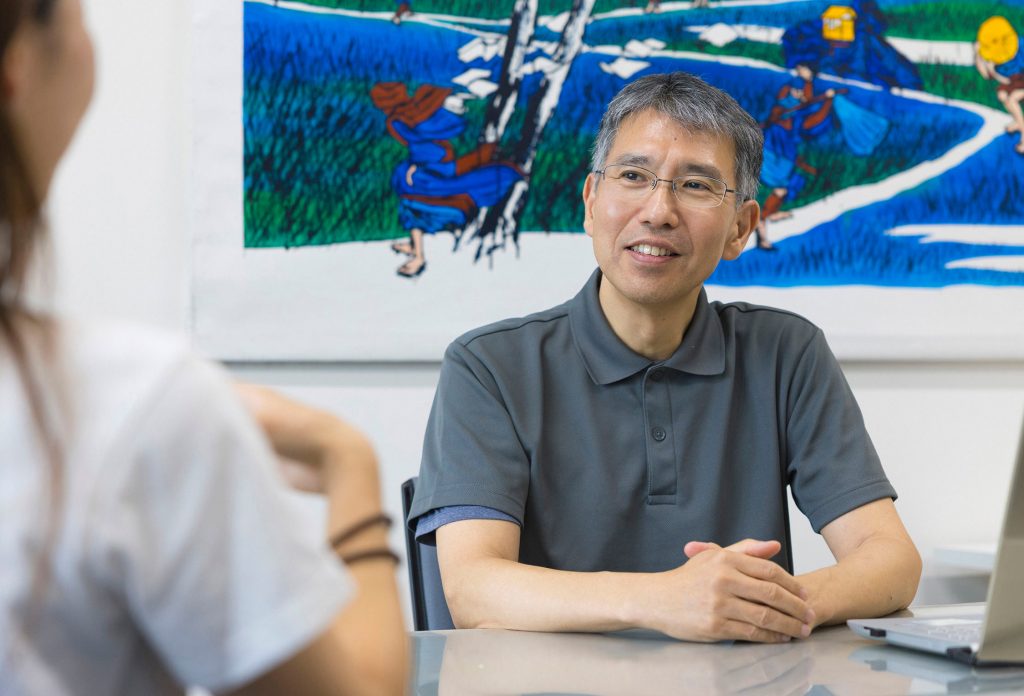
Taro Komatsu
Professor, Master’s (Doctoral) Program in Education, Graduate School of Human Sciences
International Education Development aims to build nations and people through education. Spanning politics, economics and sociology, it asks graduate students to learn a variety of research methods before tackling topics they set themselves.
If you are considering graduate school, use your undergraduate years to gather experience only the field can teach, and to train the writing that sharpens your thinking.
A master’s degree raises your expertise and your value, a real asset globally. I hope these two years with her topic will be a stepping stone in Akane’s journey.


Published in Sophialogue Vol. 1 (Autumn/Winter 2026), p.22-23
※Please note that the information in this article is current as of November 2026.


