
Department of Materials and Life Sciences
Department Features
The department aims to investigate “Materials and Life” in nature (= Science), to create new materials, to recycle resources, and to develop new properties and functions. With the focus on specialties such as physics, chemistry, biology, environmental science, and materials engineering, students learn existing disciplines through a comprehensive and cross-disciplinary approach. The program provides a specialized education that aims for cross-disciplinary knowledge through the fusion of science and engineering based on examining the fundamentals of materials. This ranges from atomic/macromolecular materials to biological phenomena, with the key themes of Substances and Nanotechnology, Harmonization between the Environment and Life, and Creation of Highly Functional Materials.
Developing a view of matter and life through experimentation
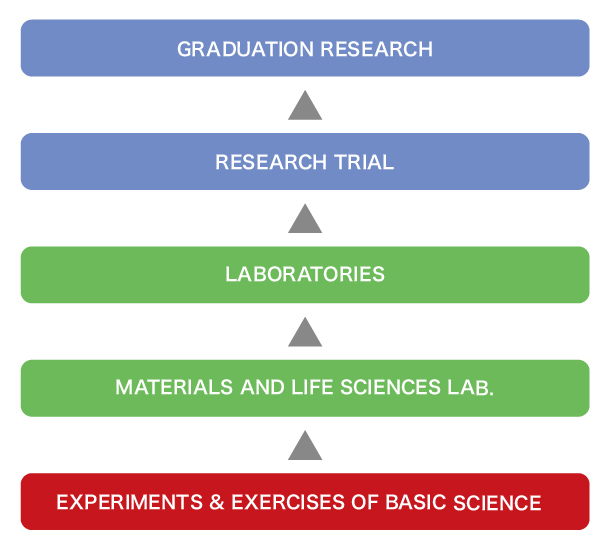
Through the Departmental Core Courses and laboratory classes on materials and life, students acquire the ability to contribute to the creation of substances ranging from atoms or molecules to polymers and biomolecules. The laboratory classes feature flexible and step-by-step programs. Students conduct basic experiments in physics, chemistry, and biology (colored in red), then step up to Department Specialized Courses (colored in green), and proceed to graduation research (colored in blue) through Research Trials (practical laboratory experience course).
Curriculum
The aim of the program is for students to acquire “combined intelligence,” which is the integration of physics, chemistry, biology, environmental science, and other disciplines while focusing on a certain area of expertise. The first year, students take General Courses and in the second year, they begin to study materials and life sciences and conduct experiments and exercises in various fields. In the third and fourth years, students study courses from three themes (Group A to C) intersecting the academic disciplines, and classes are chosen from three academic disciplines: Chemistry & Applied Chemistry, Environmental & Life Sciences, and Materials & Molecular Sciences, enabling students to focus on their choice of fields.
as of 2026
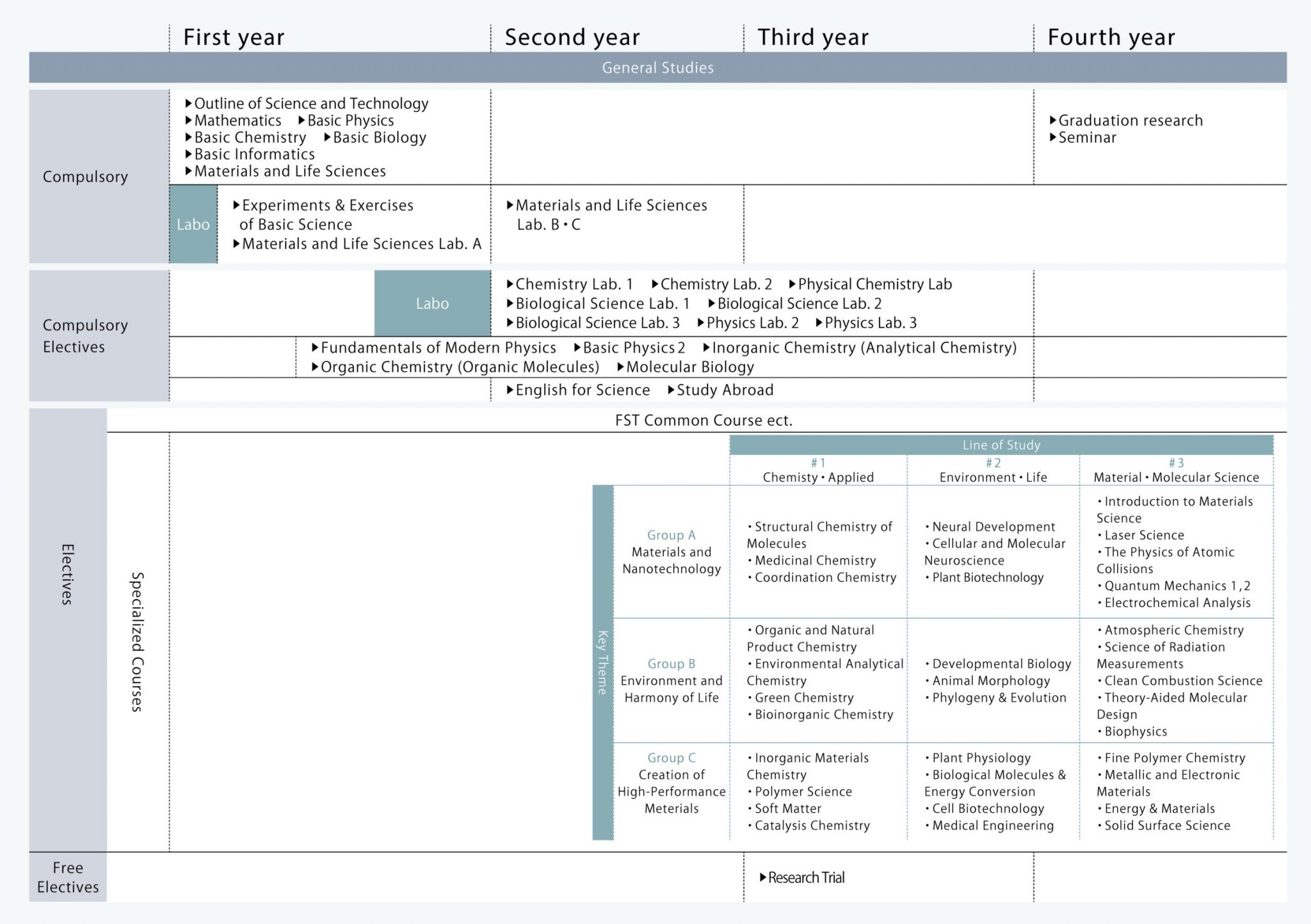
* For further information on the courses, please refer to the Syllabus.
Course Examples
- Medical Chemistry
Students will learn how to synthesize organic compounds, which is considered useful for developing pharmaceuticals and other products, with heteroatom-derived characteristics, reactivity, and functional properties.
- Natural Organic Chemistry
Students learn how to artificially synthesize organic compounds produced in nature with various biological activities and complex structures.
- Soft Matter
This course introduces soft materials such as liquid crystals, gels, and surfactants, which exhibit intermediate characteristics between solids and liquids, and their unique features in relation to their chemical structures and physical states.
- Plant Biotechnology
Students will deepen their knowledge of genetic engineering, focusing on plant tissue culturing, transgenic technology, development of genetically modified plants, and ongoing safety and technical issues.
- Phylogeny & Evolution
Diverse living species that inhabit the earth today have evolved while adapting to their environment. This course focuses on how these species emerged and their evolutionary process in relation to their genes.
- Cell Biotechnology
This course focuses on microorganisms that have multiple metabolic pathways despite their simple structure and genomes, their ability to produce substances, and metabolic processes that are useful for environmental management and human life, as well as applications of microorganisms.
Available Teaching Licenses and Subjects
- First Category Teaching license for Junior High School (Science)
- First Category Teaching license for High School (Science)
Available Qualifications
- Hazardous Material Handler (Class 1)
Curatorial Courses are also available.
Educational Objectives and Policies
-
To have students learn academic subjects, such as physics, chemistry, biology, environmental science, and materials science, in an interdisciplinary manner, understand the fundamentals of atoms, molecules, macromolecules, and materials related to natural phenomena, and improve their ability to apply and practice what they have learned.
-
To develop human resources who have new perspectives of materials and life sciences and can work toward the sustainable integration of the global environment with science and technology, so that they can contribute to creating materials and technologies on the basis of new concepts.
-
The Department of Materials and Life Sciences aims to foster human resources with integrated knowledge based on a broad perspective and a sense of life and materials harmonized with nature. With a view to this aim, the Department sets standards for the skills and knowledge students should acquire before graduation as described below. Those who have fulfilled the requirements and have passed the thesis defense will be awarded a diploma.
- Understanding of the fundamentals of material science disciplines and safety and ethical/moral values regarding science and technology.
- The ability to understand physical, chemical and natural/living phenomena based on the fundamentals of physics, chemistry, and biology.
- The ability to systematically understand the fundamental of materials and life and contribute to the creation of substances ranging from atoms and molecules to polymers and biological materials as well as technology development.
- The ability to contribute to solving science and engineering issues leading to substances and nanotechnology, harmonization of environment and life, and the creation of high-performance material by acquiring the ability to apply and develop what one has learned theoretically and technologically.
-
In accordance with the Diploma Policy, the Department of Materials and Life Sciences constructs its curriculum as follows:
- To understand the fundamentals of natural science disciplines and acquire safety and ethical/moral values regarding science and technology through coursework in Science and Technology Category I General Courses.
- To acquire the fundamentals of the natural sciences in general, including physics, chemistry, biology, informatics, and mathematics through coursework in Faculty of Science and Technology Category II General Courses and simultaneously acquire skills in English comprehension and expression by becoming familiar with science and technology-related English communication.
- To acquire the ability to contribute to the creation of substances ranging from atoms and molecules to polymers and living molecules through coursework in Departmental Core Courses on materials and life (lectures and laboratory classes in physics, chemistry, and biology).
- To study highly academic contents on substances and nanotechnology, harmonization between environment and life, and the creation of high-function materials (Departmental Specialized Courses) and thus acquire problem-solving approaches to applied and emerging disciplines, interdisciplinary fields and human society.
- To acquire the qualities of a researcher through small-group education where cutting-edge disciplines are understood through graduate research and seminars, and findings are presented, thus acquiring the ability to apply and develop what has been learned theoretically and technologically.
-
The Department of Materials and Life Sciences seeks students with the potential to contribute to the unraveling of various phenomena of the natural sciences as well as technological development and the creation of new materials. We seek students interested in the harmonization of nature and science and technology and motivated to build new visions of materials and life that fit well with nature:
- Those who fully understand high school level mathematics, science and English
- Those who can think logically posses a broad perspective, and have good communication skills
- Those who show keen interest in natural science as well as eagerness toward contributing to the elucidation of various natural science phenomena, the creation of new materials, and technological development.
Faculty Members
Toyonobu USUKI Professor
| Related Articles |
|---|
Hiroshi UCHIDA Professor
| Related Articles |
|---|
Kunihiro OKADA Professor
Takeshi ODAGIRI Professor
Mari KAWAGUCHI Professor
| Related Articles |
|---|
Nobuyuki KANZAWA Professor
| Related Articles |
|---|
Yoshikazu KIKAWADA Professor
| Related Articles |
|---|
Nobuhiko KUZE Professor
| Related Articles |
|---|
Jiro KONDO Professor
| Related Articles |
|---|
Noriyuki SUZUKI Professor
| Related Articles |
|---|
Yumiko SUZUKI Professor
| Related Articles |
|---|
Kazuo TAKAHASHI Professor
| Related Articles |
|---|
Yuko TAKEOKA Professor
| Related Articles |
|---|
Hirotaka NAGAO Professor
| Related Articles |
|---|
Shinkoh NAMBU Professor
| Related Articles |
|---|
Takeshi HASHIMOTO Professor
| Related Articles |
|---|
Masahiro FUJITA Professor
| Related Articles |
|---|
Makoto FUJIWARA Professor
| Related Articles |
|---|
Seba FUYUTSUKI Professor
| Related Articles |
|---|
Masamitsu HOSHINO Professor
| Related Articles |
|---|
Satoshi HORIKOSHI Professor
| Related Articles |
|---|
Kensuke HAYASHI Special Contract Professor
| Related Articles |
|---|
Yoko OTSUBO Associate Professor
Nobuhiro KURABAYASHI Associate Professor
Kunihito TANAKA Associate Professor
| Related Articles |
|---|
Nobuhiro SUZUKI Associate Professor
| Related Articles |
|---|
Shinji HARADA Associate Professor
Tomoyo MISAWA Associate Professor
| Related Articles |
|---|
Tetsuo YASUGI Associate Professor
| Related Articles |
|---|
Yukie YOKOTA Associate Professor
| Related Articles |
|---|
Myra VILLAREAL Assistant Professor by Special Appointment
| Research Areas | Cellular signaling modulation by natural products |
|---|
Tania PENAFLOR Assistant Professor by Special Appointment
| Research Areas | Development of new synthetic techniques for bioinert-bioactive compounds and the investigation of their interfacial interaction and biological evaluation for biomedical applications |
|---|