

Tokyo’s Streets Reveal Hidden Gaps in Urban Inclusion and Quality


Researchers mapped street quality and population composition across Tokyo, revealing local mismatches that could guide targeted and sustainable urban planning
Tokyo’s street-space quality changed little overall between 2015 and 2024, but citywide averages concealed growing local disparities.
By comparing street conditions with an inclusion-relevant population composition proxy on a 100 m × 100 m grid, researchers found that areas where population composition outpaced street quality expanded toward eastern and bayside Tokyo.
The findings offer a way to identify neighborhood-level gaps and help local governments target urban renewal, public spaces, transport, and services.
Citywide measures of urban sustainability can conceal sharp differences between neighborhoods. A city may appear to provide good streets overall while some areas lack greenery, openness, or pedestrian-friendly space where diverse populations live. For Sustainable Development Goal 11 (SDG 11), which calls for inclusive, safe, resilient, and sustainable cities, averages alone may miss where everyday street environments fail to keep pace with local needs.
Addressing this challenge, a research team led by Professor Xuepeng Qian from the Graduate School of Global Environmental Studies, Sophia University, Japan, along with Associate Professor Liang Dong from the Department of Public and International Affairs, City University of Hong Kong, China, compared street-space quality (SQ) with an inclusion-relevant socio-demographic composition proxy (SI) across Tokyo.
The team also included Shujie Sun and Jiushuai Zhao from Sophia University; Yujin Huang and Jinming Yan from Renmin University of China; Hanwei Liang from Nanjing University of Information Science & Technology; Chenyang Wang from Xi’an Jiaotong University; and Jian Zuo from Adelaide University.
Using street-view imagery and small-area demographic statistics, they mapped both dimensions on a 100 m × 100 m grid and examined spatial mismatch over 2015–2024. SI reflects population composition across dimensions including age, gender, nativity, occupation, household characteristics, and residential duration; it is not a direct measure of realized inclusion. Their findings were available online on June 4, 2026, in Volume 6 of npj Urban Sustainability.
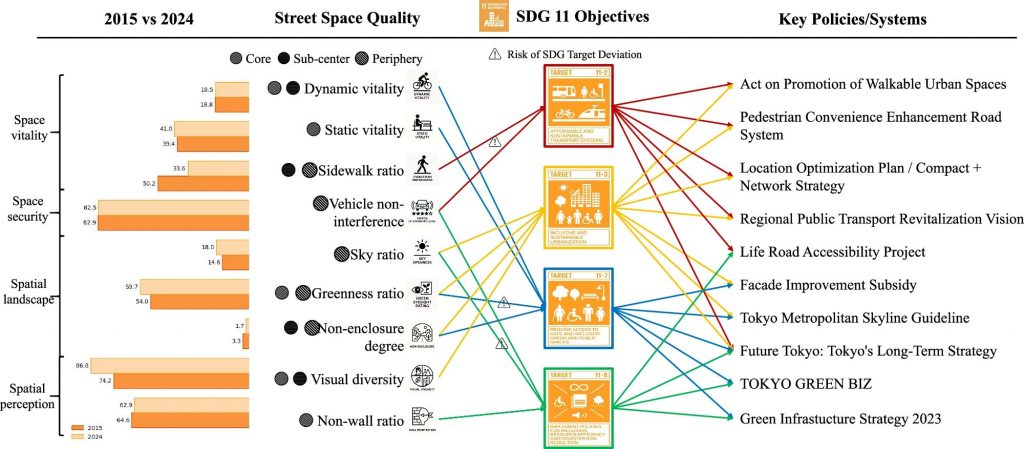
The analysis found that Tokyo’s average SQ changed little over the study period, masking contrasting shifts in individual features. Street vitality and some pedestrian and street-interface indicators improved, while greenery, sky view, openness, and non-vehicle interference stagnated or declined. The researchers identified areas where inclusion-relevant population composition outpaced street-space provision (SI ≫ SQ), and places where street-space quality was comparatively strong relative to population diversity (SI ≪ SQ). The first mismatch expanded toward eastern and bayside Tokyo, revealing local gaps hidden by citywide averages.
“Urban sustainability should not be judged by citywide averages alone,” Prof. Qian said. “Comparing population composition with the street environment at a fine spatial scale can reveal where these dimensions are not keeping pace with each other.” The study offers a diagnostic for identifying where planning priorities may need to differ, rather than treating every neighborhood as if it faced the same challenges.
Local governments could use these maps to prioritize place-specific measures. Where SQ lags SI, actions could include improving walkability, adding street greenery, making public spaces more accessible, and strengthening transport and public services. Where SQ is relatively high but SI is low, policy may instead focus on social integration, employment, housing, and service access rather than physical upgrades alone. The mismatch indicator could inform urban renewal, budget allocation, and local SDG 11 monitoring, helping officials coordinate transport, land use, public space, and social-service planning.
“Regularly updating this diagnostic could help local authorities identify priority areas earlier and coordinate investment across departments,” Prof. Qian said. The authors emphasize that the analysis describes spatial patterns and policy context; it does not establish that particular policies caused the observed changes. Future work could combine more frequent imagery and demographic data with residents’ perceptions and behavior and use quasi-experimental methods to test which interventions reduce mismatches. Applying the framework in other cities would require suitable local data, calibration, and validation.
Overall, the study presents a street-scale way to make hidden inequalities in urban environments more visible and translate SDG 11 into place-specific governance priorities. Its central message is that population composition and street-space provision should be assessed together, while recognizing that SI is a proxy rather than a direct measure of lived inclusion.
Reference
- Title of original paper
Street view diagnostics of inclusion and street quality gaps to guide governance in Tokyo
- Journal
npj Urban Sustainability
- Authors
Shujie Sun1,2, Yujin Huang3,4, Jiushuai Zhao2, Hanwei Liang5, Chenyang Wang6, Jinming Yan3, Jian Zuo7, Xuepeng Qian2 and Liang Dong1,4,8
- Affiliations
¹Department of Public and International Affairs, City University of Hong Kong, Hong Kong, China
²Graduate School of Global Environmental Studies, Sophia University, Tokyo, Japan
³School of Public Administration and Policy, Renmin University of China, Beijing, China
⁴School of Energy and Environment, City University of Hong Kong, Hong Kong, China
⁵School of Geographical Sciences, Nanjing University of Information Science & Technology (NUIST), Nanjing, China
⁶School of Human Settlements and Civil Engineering, Xi’an Jiaotong University, Xi’an, China
⁷School of Civil Engineering and Construction Management, Adelaide University, Adelaide, Australia
About Professor Xuepeng Qian
Prof. Xuepeng Qian is a Professor at the Graduate School of Global Environmental Studies and Director of Institute for Studies of the Global Environment Sophia University, Tokyo, Japan.
He received his Ph.D. in engineering in 2007 from the Graduate School of Science and Engineering, Ritsumeikan University. His fields include urban and regional planning and environmental analysis. He specializes in urban and environmental planning and studies sustainable behavior, urban social systems, and resource sustainability through systems approaches, with over 100 publications in journals and books. His research explores urban and regional sustainability and pathways for sustainable development.
He has taught seminar students from more than 20 countries and conducts research and teaching across social science and engineering departments.
Funding information
This work was supported by the National Natural Science Foundation of China (grants 72061137071 and 72134008), the National Social Science Fund of China (grant 21&ZD121), the Guangdong Natural Science Foundation (grant 9240146), and the Dutch Research Council (NWO) through the project “Towards Inclusive Circular Economy: Transnational Network for Wise-waste Cities (IWWCs)” (grant 482.19.608).
Media Contact
Office of Public Relations, Sophia University (sophiapr-co@sophia.ac.jp)


