


Ryo Miyairi
Associate Professor
Department of Luso-Brazilian Studies
Faculty of Foreign Studies


Among the works of Brazilian literature that are gradually becoming known in Japan, the literature of the northeast region called Nordeste has an appeal completely different from our image of Brazil. Associate professor Ryo Miyairi from the Faculty of Foreign Studies talks about the profoundness of Brazilian literature and the significance of learning foreign languages.
Often known for samba, Carnival, and soccer, the prevailing image of Brazil is that of a lively, flamboyant country. On the other hand, its literature is dominated by socialist and realist works. While appearing plain at first glance, there are many substantial works that delve deeply into the dark side of human nature.
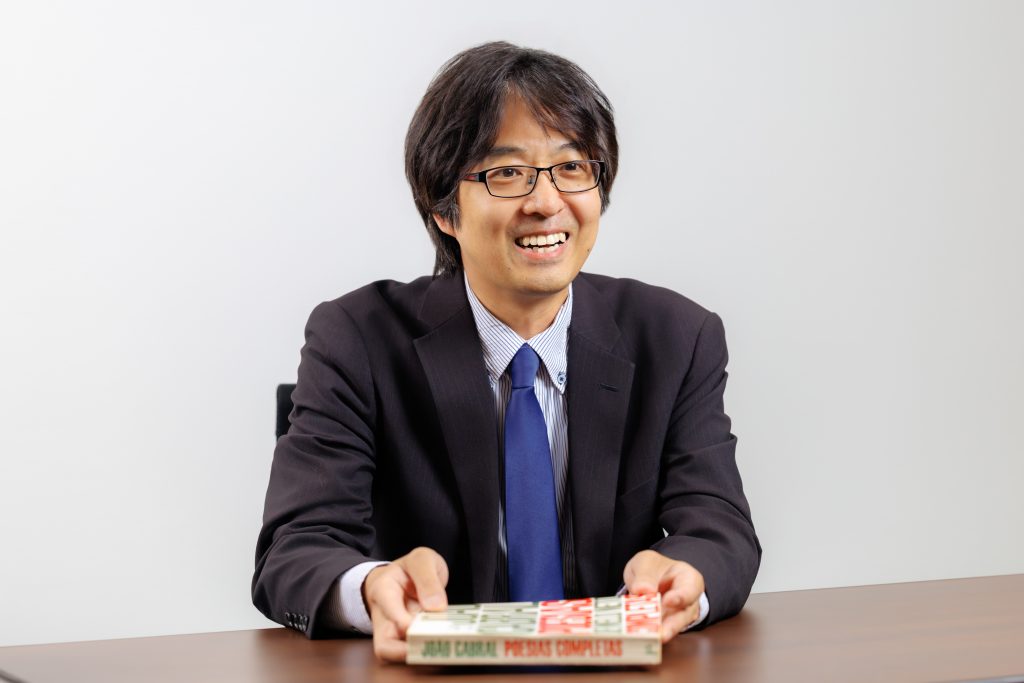
I study the northeast region called Nordeste, a place far removed from the typical image of Brazil. I was drawn to this region after discovering the poem “Num Monumento à Aspirina (On a Monument to Aspirin)” by João Cabral de Melo Neto. He suffered from migraines and wrote the poem as a tribute to aspirin, a medication for headaches.
Having long been fond of French Surrealism, I was captivated by this eccentric poem that resonates with the European avant-garde. Upon further research, I found that João Cabral de Melo Neto was a poet who wrote deeply about the social issues of Nordeste. Since then, I have been studying the literature and culture of that region.
Nordeste’s poverty and rich culture depicted by two poets
The play “Morte e Vida Severina (The Death and Life of a Severino)” is one of João Cabral de Melo Neto’s representative works. The sertão, a semi-arid region in the interior of Nordeste, sees sporadic droughts that can drive its inhabitants away from their homes, turning them into refugees known as retirantes.
This work follows the protagonist, a retirante, on a journey from the sertão, passing through the coastal sugarcane belt to reach Recife, a major city in northeastern Brazil. Along the way, the various aspects of poverty are laid bare: the structural issues where large landholdings and monoculture exacerbate poverty, and the destitute life that follows migrants even after they reach the city. Through these realities, João Cabral de Melo Neto gave a pointed description of the poverty issue in Nordeste.
In contrast to João Cabral de Melo Neto was Ariano Suassuna. He was also a writer from Nordeste, but he highlighted the region’s rich culture. His masterpiece, “Auto da Compadecida (Play of Our Lady of Mercy),” draws heavily on themes from cordel literature, a form of popular oral literature.
As stories passed down through songs, cordel literature is embraced by people who, due to poverty, lacked proper education and were illiterate. Furthermore, a unique form of faith known as folk Catholicism—which differs significantly from orthodox Catholic doctrine—is found in Nordeste.
Characterized by a pursuit of blessings and benefits in this life, there is a predetermined saint for each supplication, such as finding a partner or curing a disease. Gratitude is offered when prayers are answered, but when they are not, complaints may be voiced or a saint’s statue may even be roughly handled. “Play of Our Lady of Mercy” vividly portrays this unique faith.
Foreign languages open new doors in life
I came across the research theme of Nordeste literature because I learned Portuguese. Today, the significance of language learning is being questioned due to the emergence of artificial intelligence, but foreign languages are not merely tools for communication.
When I use Portuguese, I feel as though a switch has flipped and I become a different person. My way of speaking, thinking, and even my physical senses change, bringing me closer to a different culture. Foreign languages open new doors in life, revealing completely unknown worlds beyond.
For me, that was the literature of Nordeste, which calls out to the depths of human nature. I hope to convey an unknown side of Brazil that lies beyond the stereotypes.
The book I recommend
“Geografia da Fome”(The Geography of Hunger)
by Josué de Castro, Japanese translation by Kunio Osawa, Miki Shobo

This book classifies and analyzes hunger and poverty in Brazil by region and proposes tailored solutions. Reading it gave me a deep understanding of the social context and issues mentioned in the poems by João Cabral de Melo Neto, and I felt that I made significant progress in my research.
-
Ryo Miyairi
- Associate Professor
Department of Luso-Brazilian Studies
Faculty of Foreign Studies
- Associate Professor
-
Graduated from the Department of Luso-Brazilian Studies, Faculty of Foreign Studies, Sophia University, and withdrew from the doctoral program of the Graduate School of Global Studies, Tokyo University of Foreign Studies after receiving his Ph.D. by dissertation. Took on the position of assistant professor at the Department of Luso-Brazilian Studies, Faculty of Foreign Studies, Sophia University before assuming his current position in fiscal 2026.
- Department of Luso-Brazilian Studies
Interviewed: June 2026


