

The dream from Age Five That Now Drives the Future of Drug Development
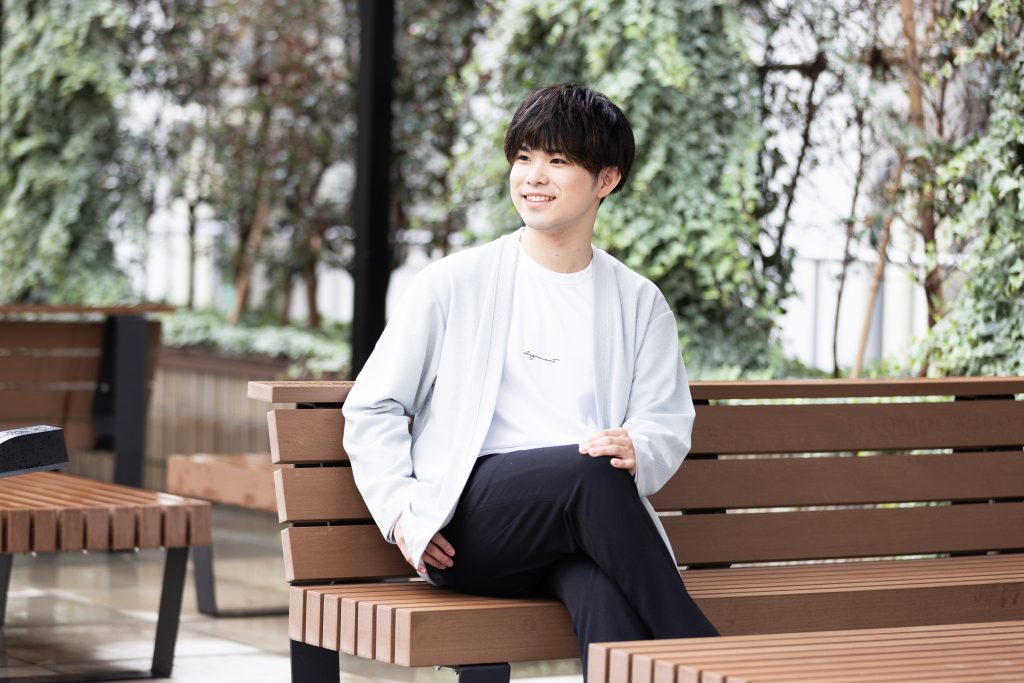
Shin Ando
Biological Science Division, Graduate Program in Science and Technology



Study abroad, extracurricular activities, clubs, volunteer work, internships – fulfilling their dreams to grow themselves as individuals. Students who have challenged themselves speak about how they’ve changed and grown from enrollment to the present.
Pursuing early graduation on the path to becoming a researcher
――Why did you choose the Faculty of Science and Technology at Sophia University?
When I was five, my mother was diagnosed with a rare disease for which there was no effective treatment. That experience led me to decide to pursue a career in pharmaceutical science. I came to believe that addressing diseases modern medicine cannot yet cure requires new scientific approaches. In my first year of high school, I became interested in two advanced fields, biophysics and nucleic acid therapeutics. When I learned that Sophia University was the only institution in Japan conducting research that integrates these two areas, I decided to apply. I was also drawn to Sophia’s curriculum, which allows students to continue studying across a broad range of disciplines rather than narrowing their focus too early.
――What mindset have you had as you worked toward becoming a researcher?
I work toward big goals by breaking them into smaller steps and focusing on what I can do next. I read many specialized books, and since my first year of high school, I have looked for information on my own and joined university seminars and study groups to deepen my learning. From a young age, I tended to ask “why,” and when I did, my mother would ask me in return, “Why do you think so?” I believe those conversations helped me develop the habit of questioning and exploring ideas.
――What class made a lasting impression on you during your undergraduate years?
It was a class called History of Japanese Dictionaries, one of the University-wide General Education Courses. The class explored history through dictionary definitions, which clearly reflected the social context of each period. We examined the same words in dictionaries from different eras, from the past to the present, and connected changes in meaning with their historical backgrounds. By linking individual ideas and seeing how they expanded into broader perspectives, the class helped me broaden my view. I feel that this process of questioning and clarifying the logic behind things is one of the defining features of university learning.
――Now that you are a graduate student, how did you learn about the early graduation program, and what was your student life like at that time?
I stayed focused on my goals while making a conscious effort to keep an open mind. I spoke with professors from a range of laboratories, including those in chemistry and biology, to explore different research areas. Through these conversations, I learned about the early graduation option for students planning to pursue a doctoral degree. I first became aware of it in the summer of my first year, and from then on, it became a clear goal. Having this goal kept me motivated and deeply engaged in my studies. My third year was demanding, however, as I balanced coursework, experiments, and research while preparing to graduate early.
Innovating Treatments for Intractable Diseases Through Biophysics and Oligonucleotide Therapeutics
――Could you tell us about your research?
My research focuses on nucleic acid therapeutics from a biophysical perspective. Nucleic acids refer to DNA and DNA‑like molecules, and nucleic acid therapeutics are drugs developed using these molecules. Biophysics applies physical principles to biological systems, and my work centers on analyzing the three-dimensional structures of these molecules. Designing drugs based on molecular shape allows researchers to rationally create new types of treatments that may be effective even for intractable diseases. For this reason, I work on both fundamental research to understand the structures of nucleic acids and applied research that uses these insights to design new nucleic acid therapeutics.
――What is your life like as a graduate student?
Graduate school feels completely different from my time as an undergraduate, as research now takes center stage. In my case, the work is highly independent, so I develop my own plans and move my research forward with considerable flexibility. Early graduation has also given me the chance to connect not only with peers in my cohort but with students a year ahead of me, which has been a meaningful part of my experience. At this point, I hope to pursue a career as a researcher in academia. What I find especially rewarding about this environment is not just the academic freedom it offers, but the opportunity to work closely with professors who have truly mastered their fields. Being surrounded by people with such deep knowledge and experience continually pushes me to improve, and I feel this has played a significant role in my personal growth.
――What message would you like to share with current students?
Graduate school is a place where you can fully immerse yourself in research. There is real excitement in building on what you have learned, exploring new ideas, and charting your own path. I hope you stay curious, keep an open mind, and continue to challenge yourself.
My Best Moment
My first academic conference presentation
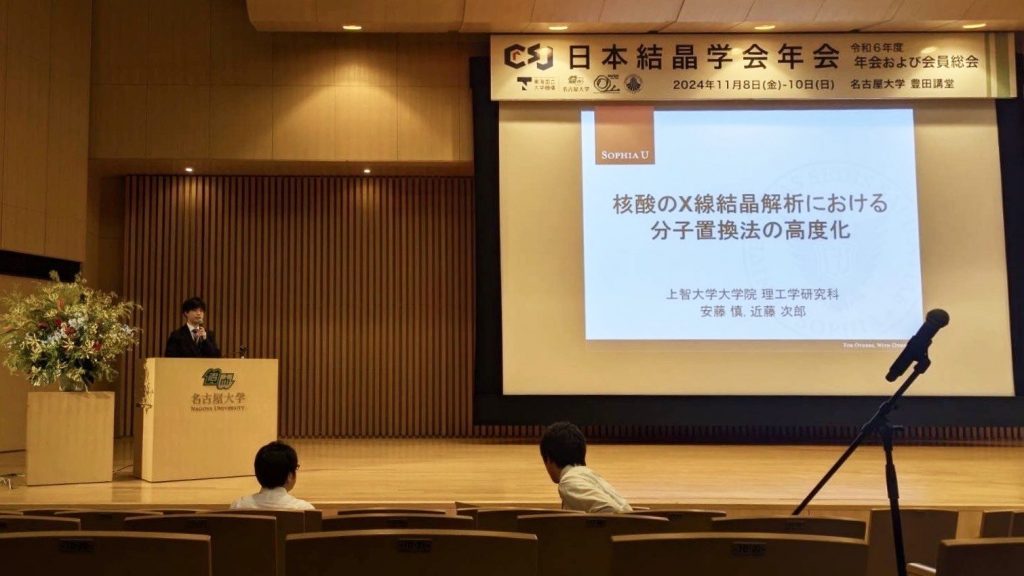
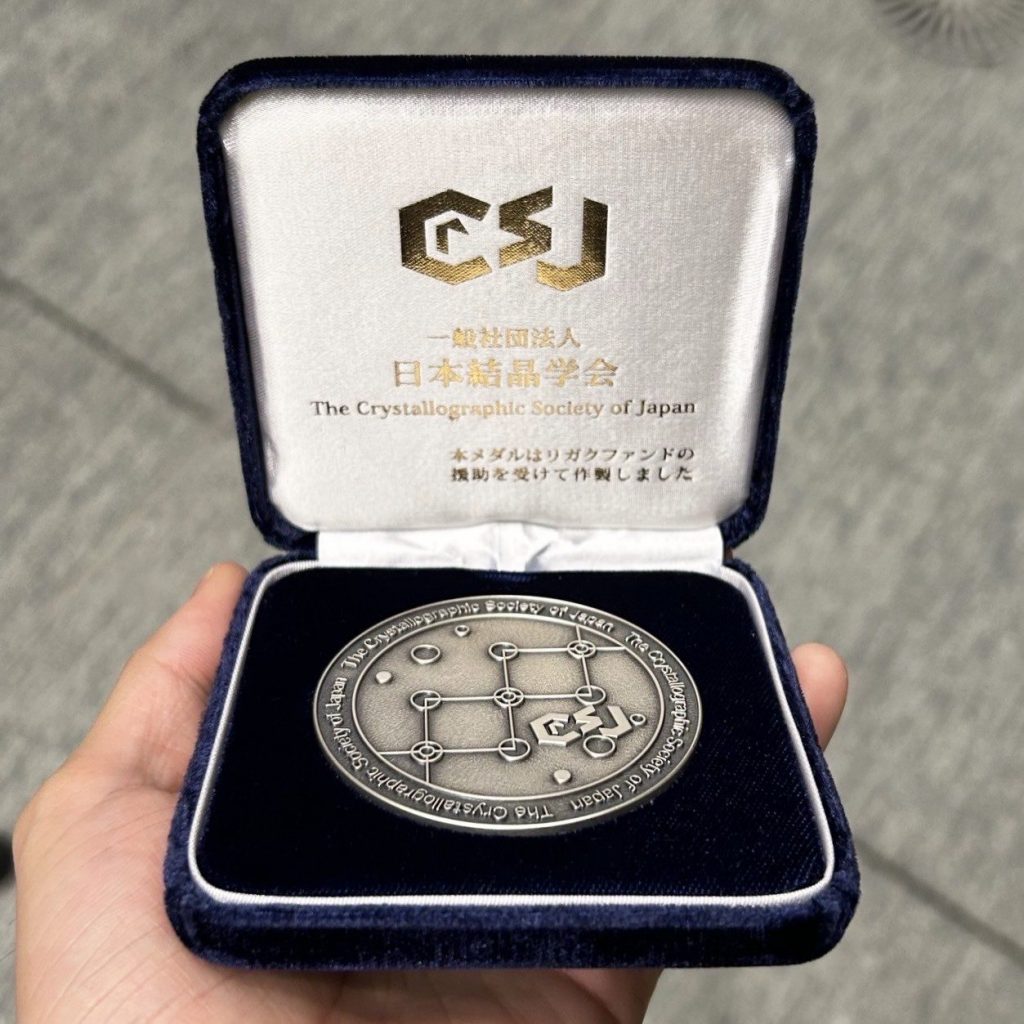
In 2024, I attended academic conferences for the first time, including an international conference on nucleic acid chemistry. Presenting my research gave me the opportunity to exchange ideas with researchers from around the world, including leading figures in the field. These experiences were not only valuable in helping me think about future research directions, but also truly exciting! The photos here were taken at a meeting of the Crystallographic Society of Japan, where I presented both orally and through a poster session, and was honored to receive an award.
※Please note that the content of this article is correct as of October 2024