

Department of Economics (SPSF)
Educational Policy
As part of the Sophia Program for Sustainable Futures (SPSF), the Department of Economics educates students in the academic discipline of economics and its applications to understanding social and economic phenomena. Our education aims at enhancing logical thinking capabilities and developing analytical and data analysis skills in order to solve real-world problems and design policies for a sustainable future.
The first-year curriculum focuses on basic economic concepts, such as macroeconomics and microeconomics, whilst also emphasizing quantitative skills. In subsequent years, students study advanced economic theory and apply newly learnt analytical skills to examine various issues associated with developing sustainable societies in a range of settings. In addition, the curriculum is structured so that students can undertake a wide range of courses in other departments and, in doing so, develop knowledge of other areas where economic concepts can be applied. Courses run by the Department of Economics feature small class sizes in order to promote active discussion between students and lecturers. We welcome self-motivated applicants who are interested in learning how economics can be employed to improve understanding of the socio-economic challenges occurring in modern society.
Curriculum
as of 2025
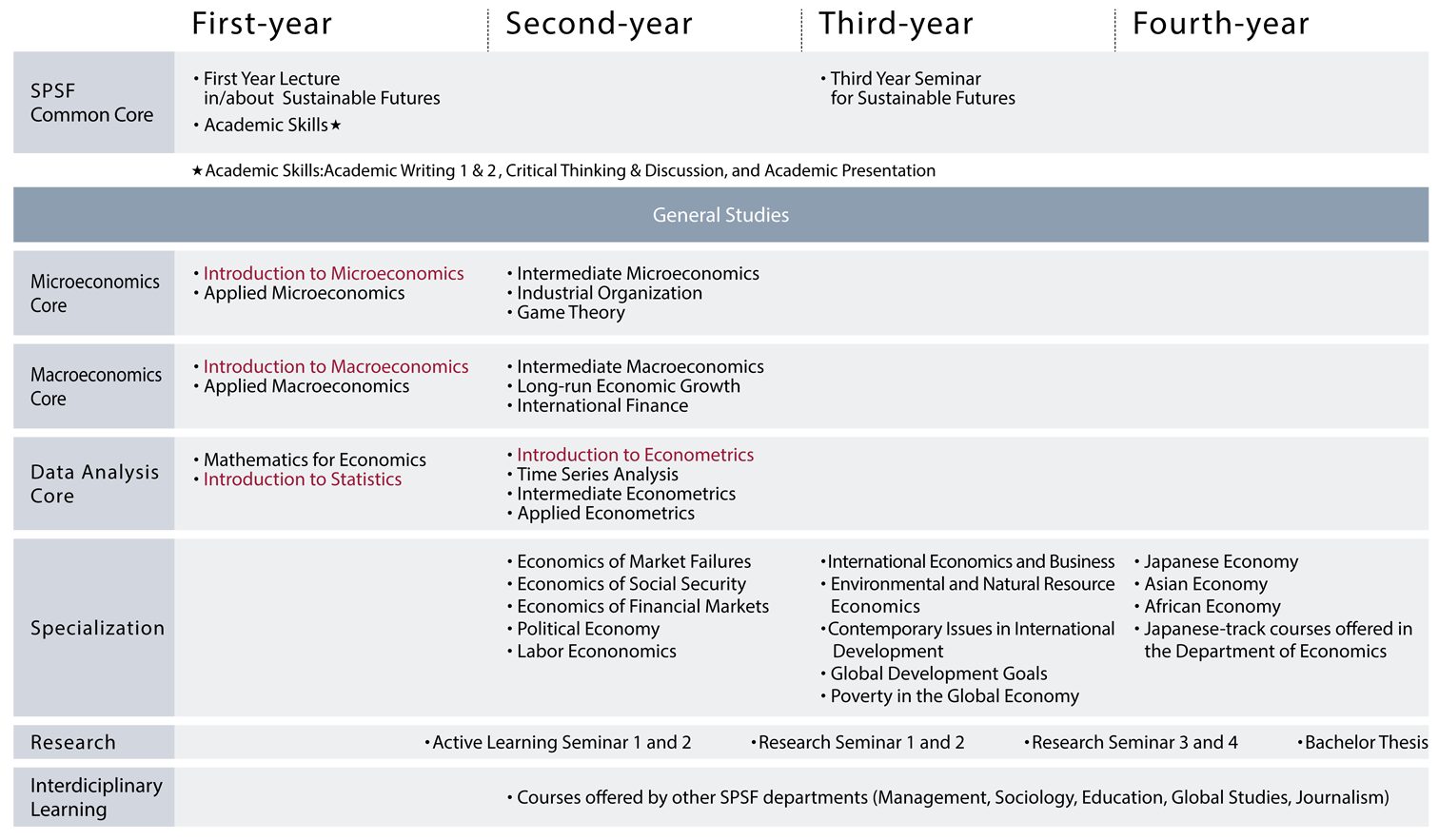
NOTE: Courses in red indicate compulsory courses.
* Please refer to the syllabus for more information on the courses.
Educational Objectives and Policies
-
To pursue in-depth study of fundamental micro- and macro-economic theory, through seminars, lectures and other types of small-class teaching, and to theoretically and empirically examine issues related to economics in contemporary society.
-
To produce graduates capable of applying economic concepts and tools to analyse contemporary social problems and phenomena; and of developing innovative ideas, utilising economic conepts, and analytical skills to critically examine global society.
-
The Department of Economics sets standards for the skills and knowledge that students are required to achieve prior to graduation. Those who fulfill the graduation requirements will be awarded a diploma, being deemed to have acquired the following:
1. In-depth understanding of the approaches and concepts used in microeconomics and macroeconomics, which constitute the core of economic theory; and the ability to explain the concepts in their own words.
2. The ability to develop models or conceptual frameworks based on knowledge of economics, in order to explain economic and social problems in modern society and suggest viable approaches to solving the problems.
3. The ability to utilize economic knowledge and skills to perform statistical data analysis.
4. High-level communication and leadership skills that enable an appropriate contribution to be made to the global community.
5. High-level expertise that enable each student to become a leader in modern society in accordance with their own individual qualities and interests.In addition to the above, the SPSF course sets the following abilities which students should acquire before graduation as common requirements across its six departments (Department of Journalism, Department of Education, Department of Sociology, Department of Economics, Department of Management, Department of Global Studies).
6. The ability to learn the basic knowledge on “Sustainable Futures,” to understand its importance, and to take action towards resolving challenges to the sustainable futures by drawing upon their academic discipline as well as from the other five disciplines in the SPSF course they learn.
7. The ability to understand and apply the interdisciplinary perspectives and methodologies, learned in their academic discipline and in the other five disciplines of the SPSF course, when addressing issues and presenting their ideas.
-
For the purpose of achieving the requirements of the Diploma Policy, the Department of Economics has structured its curriculum as follows:
1. Students acquire fundamental knowledge of economic theory through Compulsory Courses (Introduction to Macroeconomics and Introduction to Microeconomics).
2. Students to gain logical thinking skills and develop models to describe and analyse socioeconomic phenomena through applied Microeconomics and/or Macroeconomics ( which are Elective Compulsory Courses).
3. Students acquire statistical analysis skills through data analysis courses (Introduction to Statistics and Introduction to Econometrics)
4. Students are provided with the opportunity for group discussions and group learning through Active Learning Seminars and Research Seminars so that they acquire the communication skills necessary to enable problem solving in cooperation with others.
5. From a global perspective, a diverse range of Specialized Courses is offered (International Economics and Business, Environmental and Natural Resource Economics, Contemporary Issues in International Development, International Finance, etc.) as Elective Compulsory Courses to deepen students’ understanding of applying economic theory to modern society.
6. Based on the fundamental knowledge required in the common goals described in the Diploma Policy and in order to support students to acquire expertise while exploring their own individual qualities and interests, students are able to select various Specialized Courses, including courses offered by other departments and faculties, in addition to advanced economics courses.In addition to the above, the SPSF course constructs its curriculum in the following manner, for the purpose of achieving the common diploma policy across the six departments:
7. To enable the students during the first year to acquire a basic knowledge on “Sustainable Futures” and the relating issues through the SPSF General Studies Courses, drawing on the perspectives of six disciplines. Based on the acquired knowledge, the students will be able to deepen their understanding in various challenges related to the sustainable futures through Elective Courses in the University-wide General Studies Courses, and they will be also able to learn about the approaches, contents, and methodologies of the different disciplines through Specialized Courses offered by each department.
8. To enable students to gradually gain knowledge of the different disciplines of each Department and also acquire a wide range of knowledge through the courses offered by other faculties and departments which have been designated to offer Elective Compulsory Courses or Elective Courses. Thus, the students will be able to acquire the various perspectives, contents, and methodologies, as well as comprehensive approaches from the courses.
-
The basic educational aim of the Department of Economics is to cultivate students’ ability to think logically to find solutions for real-life issues of modern society. “Mathematical thinking” is essential in economic logic due to the academic nature of economic models. Consequently, highly motivated students who have achieved excellent academic performance both in quantitative and language subjects are welcomed in the Department.
1. We seek students with a highl degree of interst in various issues in modern society and who are strongly motivated to contribute to society.
2. We seek students who are equipped with strong language skills (the ability to organize ideas and express them in words, both in the written and oral format, and to understand and discuss the ideas of others), good logical thinking ability, and good mathematical skills.
3. We expect students to self-motivated, understand others through dialogue, and be capable of collaborating with others to achieve certain goals.
Faculty Members
Satoshi KAWANISHI Professor

| Related Articles |
|---|
Kohei KAMAGA Professor
Hiroki KONDO Professor
Sayaka NAKAMURA Professor
| Related Articles |
|---|
John Joseph PUTHENKALAM Professor
Tetsuya HORIE Professor
Naoaki MINAMIHASHI Professor
Morihiro YOMOGIDA Professor
| Related Articles |
|---|
Masamitsu KURATA Associate Professor
| Related Articles |
|---|
Matthias SCHLEGL Associate Professor
| Research Areas | Macroeconomics,International finance,Theoretical analysis of the dynamics of inequality |
|---|---|
| Related Articles |
Yuki HIGUCHI Associate Professor
| Related Articles |
|---|
Samuel LEYTON Assistant Professor
| Research Areas | Macroeconomics,Political Economy,Labor Economics |
|---|
Masaki TAKAHASHI Assistant Professor by Special Appointment