

A Heteroatom Additive Boosts Efficiency and Longevity of Tin Perovskite Solar Cells



2-aminobenzothiazole improves longevity and photovoltaic conversion efficiency of lead-free quasi-two-dimensional tin perovskite solar cells
Tin-based perovskites are emerging as eco-friendly, lead-free photovoltaic alternatives. However, their commercial viability is currently limited due to oxidation-associated degradation that affects the efficiency and longevity of the cells.
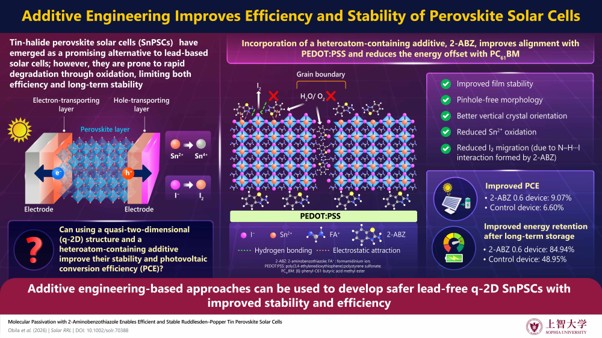
By incorporating 2-aminobenzothiazole into quasi-two-dimensional tin perovskites, researchers have recently achieved better crystal formation, reduced defect density, suppressed iodide migration, and minimized tin oxidation. The approach highlights the significance of additive engineering in improving the efficiency and stability of the solar cells.
Metal halide perovskite solar cells (PSCs) are promising candidates for next-generation photovoltaics due to their high efficiency and low manufacturing cost. While lead-based perovskite devices achieve high power conversion efficiencies, the toxicity hinders their commercialization. Researchers are now exploring the use of tin as a lead substitute to develop eco-friendly alternatives. However, tin-halide (SnPSCs) are prone to rapid degradation through oxidation, limiting both efficiency and long-term stability.
To mitigate this issue, researchers from Sophia University, Japan, and the National Institute for Materials Science (NIMS) in Japan utilized an additive engineering approach. Their study introduces 2-aminobenzothiazole (2-ABZ) into quasi-two-dimensional (q-2D) Ruddlesden–Popper tin perovskites, creating a multifunctional passivation strategy that enhances both photovoltaic performance and device longevity.
The study was led by Professor Yuko Takeoka, Faculty of Science and Technology, Department of Materials and Life Sciences, Sophia University. Dr. J. Obila, affiliated with Sophia University at the time of this research and now at North-West University, South Africa, as well as Dr. Yasuhiro Shirai and Dr. Masatoshi Yanagida from NIMS were also a part of the research team. The study findings were made available online on May 27, 2026, and published in Volume 10, Issue 11 of the Solar RRL journal on June 15, 2026.
“I’ve been researching perovskite compounds for over 25 years, and I wanted to use that knowledge to make safer solar cells, so I applied to JST ALCA-Next with the NIMS group. The acceptance of our proposal was the kick-off for this research,” mentioned Prof. Takeoka.
2-ABZ is a heteroatom molecule containing nitrogen, carbon, sulfur, and hydrogen. Unlike many additives that target a single degradation mechanism, 2-ABZ performed several complementary functions throughout the formation and operation of the perovskite film. The researchers propose that the additive functions as a multifunctional molecular stabilizer throughout the entire device architecture. By regulating crystallization, reducing trap formation, preventing ion migration, inhibiting tin oxidation, and improving interfacial energy alignment, 2-ABZ addresses several of the intrinsic weaknesses that have limited the efficiency of SnPSCs.
Prof. Takeoka explains, “The buildup of 2-ABZ at the interface is crucial for decreasing buried defects in the perovskite layer by creating densely populated nucleation sites at the base of the layer, resulting in the production of a high-quality and stable film.”
These molecular interactions have important consequences for device operation, translating into a substantial increase in solar cell performance. The optimized devices achieved a power conversion efficiency of 9.07%, compared with 6.60% for control devices used for the experiment. The additive also improved open-circuit voltage, photocurrent generation, and device reproducibility while reducing hysteresis during operation.
Besides increasing the efficiency, the molecular approach significantly enhanced the stability of the devices. Surface analysis revealed that 2-ABZ suppressed the oxidation of Sn2+ to Sn4+, a major degradation pathway for tin perovskites. X-ray photoelectron spectroscopy also showed a substantial reduction in oxidized iodine species, and time-of-flight secondary ion mass spectrometry confirmed that the migration of iodide was greatly inhibited.
The benefits were reflected in long-term performance tests. Unencapsulated solar cells containing 2-ABZ retained 84.94% of their initial efficiency after 100 days of storage, whereas untreated devices retained only 48.95%. During continuous operation under simulated sunlight, treated devices maintained nearly 89% of their original performance after 10 hours, while control devices degraded rapidly within the first hour.
Installing Si-based solar cells requires wide, flat land, but PSCs are lightweight, flexible, and shape-controllable, making them a promising next-generation solar cell. However, ensuring their efficiency and longevity is important to improve their commercial viability. “The findings from our research showed the way for developing safer lead-free solar cells, which could help expand the use of photovoltaic cells,” mentioned Prof. Takeoka.
Overall, the study highlights how carefully designed molecular additives can simultaneously improve multiple aspects of device performance. The findings provide a practical framework for engineering more stable, efficient, and environmentally friendly lead-free PSCs and may accelerate their development for the future photovoltaic applications.
Reference
- Title of original paper
Molecular Passivation with 2-Aminobenzothiazole Enables Efficient and Stable Ruddlesden–Popper Tin Perovskite Solar Cells
- Journal
Solar RRL
- Authors
Jorim Okoth Obila1,3, Chunqing Li1, Masatoshi Yanagida2, Yasuhiro Shirai2, and Yuko Takeoka1
- Affiliations
1Faculty of Science and Engineering, Sophia University, Japan
2Photovoltaic Materials Group, Centre for GREEN Research on Energy and Environmental Materials, National Institute for Materials Science (NIMS), Japan
3Department of Physics, North-West University, South Africa (current affiliation)
About Professor Yuko Takeoka
Dr. Yuko Takeoka is a Professor in the Department of Materials and Life Sciences at Sophia University, Japan. She earned her Ph.D. in Engineering from The University of Tokyo in 2001, and leads research at the interface of polymer chemistry and advanced energy materials. Her research focuses on functional polymers, organic–inorganic hybrid materials, perovskite solar cells, fluorescent materials, biodegradable polymers, biomaterials, and biosensors.
Professor Takeoka has authored more than 200 scientific publications and has received several prestigious recognitions, including being named among the Top 5% of Highly Cited Authors with RSC Journals, Royal Society of Chemistry in 2020.
Funding information
This work was supported in part by the Japan Science and Technology Agency (JST)-ALCA-Next Program (grant no. JPMJAN23B2) and Grant for Research in Priority Areas of Sophia University.
Media Contact
Office of Public Relations, Sophia University (sophiapr-co@sophia.ac.jp)