

Oxygen Collisions Reveal How Quark–Gluon Matter Approaches Equilibrium



Oxygen Collisions Reveal How Quark–Gluon Matter Approaches Equilibrium
The quark–gluon plasma, thought to have filled the universe shortly after the Big Bang, is usually studied in large nuclear collisions.
Now, researchers from Japan show that oxygen–oxygen collisions produce a mixture of equilibrated and non-equilibrated matter. Once particle multiplicity exceeds about 20, the equilibrated component becomes dominant, yet approximately 30% of the matter remains non-equilibrated even in the most central collisions, revealing that these intermediate-sized systems do not fully reach thermal equilibrium.
High-energy nuclear collisions recreate extreme conditions similar to those in the early universe, producing quark–gluon plasma (QGP), a hot state of matter in which quarks and gluons are no longer confined inside protons and neutrons. While large systems such as lead–lead collisions can produce matter that behaves like a fluid, collective behavior has also been observed in smaller systems. Oxygen–oxygen collisions offer an intermediate setting, but whether the produced matter reaches local thermal equilibrium—and therefore behaves like a fluid—has remained unclear.
Addressing this challenge, a research team led by Professor Tetsufumi Hirano from the Faculty of Science and Technology, together with graduate student Mr. Naoya Ito, a second-year master’s student, quantitatively evaluated, for the first time, the extent to which matter produced in high-energy oxygen–oxygen (O + O) collisions at the Large Hadron Collider (LHC) at CERN reaches thermal equilibrium. They used the dynamical core–corona initialization (DCCI2) model, which separates matter that reaches local equilibrium into a “core” component from particles that remain nonequilibrated in a “corona” component.
Their findings were published in the journal Physical Review C on August 12, 2026.
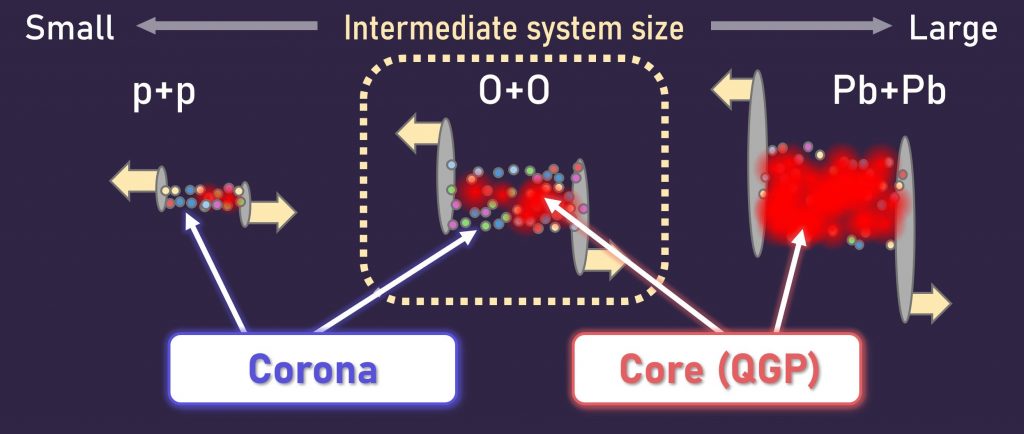
The researchers modeled O + O collisions at a collision energy of 5.36 TeV and examined how the balance between the two components changes with the number of charged particles produced near the center of the collision. In the model, the core is treated as an equilibrated medium whose evolution can be described using relativistic hydrodynamics, whereas the corona represents particles that do not fully equilibrate. This approach allowed the team to quantify how much of the produced matter behaves collectively without assuming that the entire system reaches equilibrium.
The analysis revealed a clear transition as collision activity increased. When the charged-particle multiplicity at midrapidity exceeded about 20, the equilibrated core contribution became larger than the corona contribution. However, the corona did not disappear even in the most central O + O collisions; it continued to account for approximately 30% of the total hadron yield.
“We were able to quantitatively clarify, for the first time, how far quark–gluon matter produced in oxygen collisions approaches thermal equilibrium,” Professor Hirano said. The result indicates that O + O collisions occupy an intermediate regime between systems dominated by non-equilibrated particles and those in which collective, fluid-like behavior is dominant.
Further analysis of particle momentum showed that the core contribution generally dominates at lower momenta, while the corona becomes increasingly important at higher momenta. This transition occurs at higher momentum for heavier particles, reflecting the stronger boost they receive from the collective expansion of the equilibrated core. The researchers also examined strange-baryon production. Ratios of strange baryons to charged pions increased with collision multiplicity but remained below values expected for complete chemical equilibrium. This pattern provides additional evidence that a non-equilibrated component persists even as the equilibrated contribution grows.
“Understanding the degree of equilibration is essential because studies of oxygen nuclei and their possible alpha-cluster structure rely on the assumption that the produced matter behaves like a fluid,” Professor Hirano explained. The work therefore provides a foundation for interpreting particle distributions in O + O collisions as probes of nuclear structure, while also helping clarify the conditions under which QGP forms in smaller collision systems.
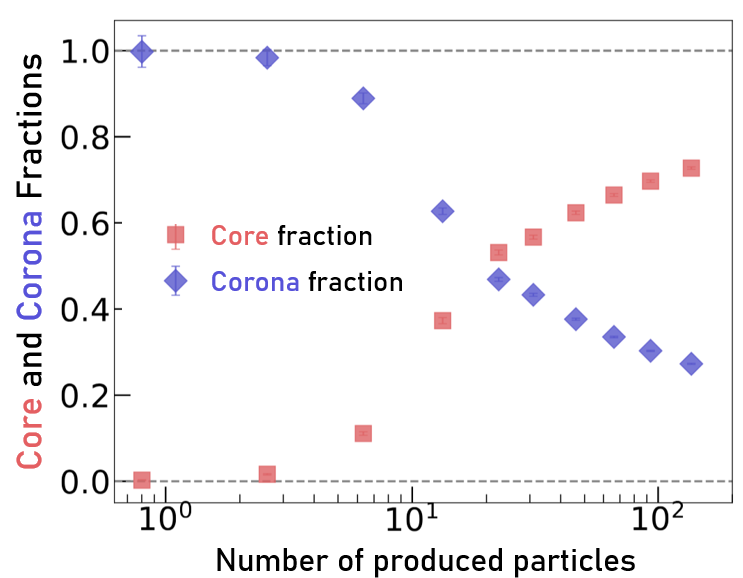
Overall, the findings show that relativistic hydrodynamics alone cannot fully describe O + O collisions because a substantial non-equilibrated component remains. The study provides a quantitative baseline for comparing future measurements from the LHC and RHIC and for investigating how QGP formation changes with system size. The researchers also aim to extend the framework to other intermediate systems, including neon–neon collisions, to explore how nuclear structure and equilibration shape the matter produced in high-energy collisions.
Reference
- Title of original paper
Equilibrated fraction of QCD matter in high-energy oxygen-oxygen collisions
- Journal
Physical Review C
- Publication date
August 12, 2026
- Authors
Naoya Ito and Tetsufumi Hirano
- Affiliations
Faculty of Science and Technology, Sophia University, Tokyo, Japan
About Professor Tetsufumi Hirano
Professor Tetsufumi Hirano is a Professor in the Faculty of Science and Technology, Sophia University, Tokyo, Japan, and Principal Investigator of the Hadron Physics Group. A theoretical physicist specializing in high-energy nuclear physics, he focuses on developing and applying hydrodynamic approaches to high-energy physics.
He earned his PhD from Waseda University. His research interests include high-energy heavy-ion collisions, quark–gluon plasma, and relativistic hydrodynamics. He is recognized as an influential scientist in the hydrodynamics community and received the Zimányi Medal for outstanding young theoretical researchers in 2011. He has authored 179 publications, which have received 6,348 citations.
Funding information
This research was supported by the Japan Society for the Promotion of Science (JSPS) Grant-in-Aid for Scientific Research (KAKENHI), Grant-in-Aid for Scientific C Research, Project Number JP23K03395.
Media Contact
Office of Public Relations, Sophia University (sophiapr-co@sophia.ac.jp)