

How the 2024 Migration Pact Reconfigured European Union Migration Governance




Study finds that EU migration governance is increasingly shaped by political bargaining among national leaders rather than by technocratic coordination
Migration and asylum policy have long been among the most debated issues in the European Union (EU), exposing divisions among member states over responsibility-sharing and border management.
A new study found that the 2024 Migration Pact transformed EU migration governance from expert-led coordination to political bargaining among national leaders. The findings reveal how migration has become a central arena of intra-EU diplomacy and suggest a shift in how political consensus is built across the EU.
Migration and asylum policy have long challenged the European Union (EU), exposing deep divisions among member states over how responsibility for asylum seekers should be shared and how the bloc’s external borders should be managed. After years of political deadlock, the EU adopted the New Pact on Migration and Asylum in 2024, a landmark agreement designed to reform the region’s migration system. However, a new study suggests that the Pact’s most important legacy may not be the policies it introduced, but the way it transformed migration governance itself.
In a study published online in the JCMS: Journal of Common Market Studies on May 17, 2026, Professor Midori Okabe from Sophia University, Japan, examined how negotiations surrounding the Pact reshaped decision-making within the EU. Rather than relying primarily on expert-led coordination among national officials and EU institutions, migration governance increasingly came to be driven by political bargaining among national leaders.
Reflecting on the motivation behind the research, Prof. Okabe says, “I was interested in why and how the EU was able to reach an agreement on migration and asylum after years of political deadlock. The negotiation process suggested that migration governance was shaped not only by technocratic coordination, but increasingly by political bargaining among member states.”
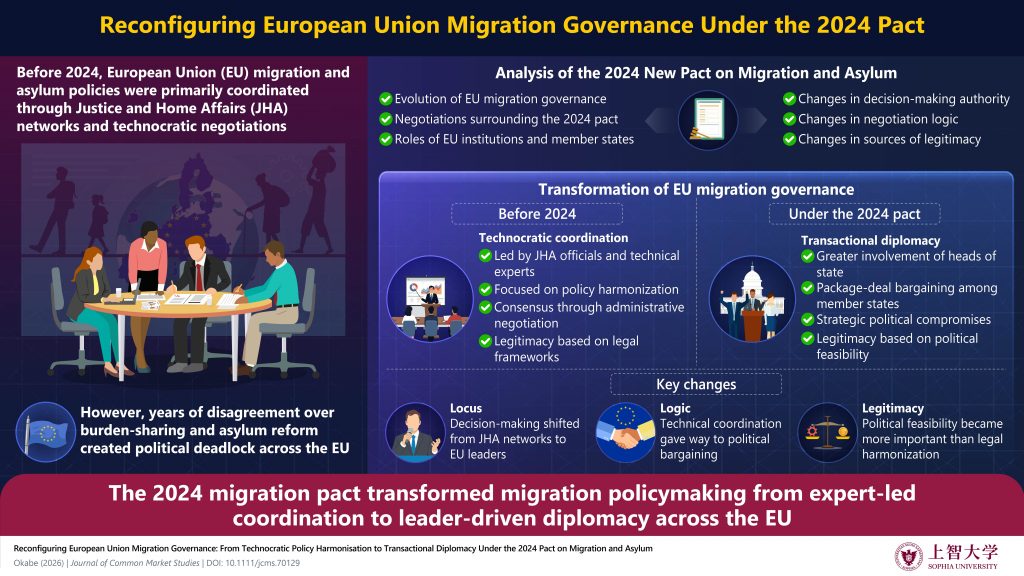
For decades, migration and asylum policies were largely coordinated through networks of Justice and Home Affairs officials. These officials worked through technical negotiations and administrative cooperation to develop common approaches across the EU. While political leaders occasionally intervened during crises, day-to-day policymaking generally remained in the hands of specialists and government officials.
The 2024 Pact, however, emerged under very different circumstances. The migration crisis of 2015 exposed weaknesses in the EU’s asylum system and intensified disagreements between member states. Efforts to reform the existing rules repeatedly stalled, particularly over the question of whether asylum seekers should be redistributed across countries. According to the study, traditional mechanisms of coordination were no longer sufficient to overcome these political divisions. To understand how the deadlock was eventually broken, Prof. Okabe analyzed the negotiations that led to the adoption of the Pact. The study examined policy documents, institutional developments, existing scholarship, and evidence from the negotiation process to trace how decision-making evolved during the reform.
Rather than viewing the Pact simply as a reform of migration and asylum rules, the study argues that it marked a deeper institutional shift in how decisions are negotiated, justified, and implemented within the EU. The analysis revealed a significant change in the center of decision-making, which moved away from networks of officials and toward high-level political forums involving heads of state and government.
The study also found that negotiations increasingly relied on political trade-offs and package deals that linked migration policies to broader issues, including border management and cooperation with non-EU countries. This reflected what the study describes as a shift toward “transactional diplomacy,” a form of negotiation in which political compromises are exchanged across multiple policy areas to secure agreement among member states.
As a result, migration governance evolved from a primarily technocratic process into a central arena of intra-EU diplomacy. Political leaders played a much greater role in shaping outcomes, while negotiations became increasingly focused on securing agreements that could accommodate diverse national interests. “This study examines the structural transformation through which EU migration governance has become a central agenda of intra-EU diplomacy, shifting from technocratic coordination led by Justice and Home Affairs officials to high-level political bargaining among member states,” explains Prof. Okabe.
The findings also point to broader implications for the future of European integration. As migration continues to be a politically sensitive issue across the continent, decision-making may increasingly depend on negotiations among national leaders rather than on technical coordination among policy experts. This could reshape how the EU responds to future migration challenges and how solidarity among member states is defined in practice.
The study suggests that the 2024 Pact did more than resolve a legislative deadlock. It redefined who shapes migration policy within the EU and how political consensus is built. As future migration challenges emerge, the Pact may be remembered not only for the policies it introduced but also for the new model of governance it established.
Reference
- Title of original paper
Reconfiguring European Union Migration Governance: From Technocratic Policy Harmonisation to Transactional Diplomacy Under the 2024 Pact on Migration and Asylum
- Journal
JCMS: Journal of Common Market Studies
- Author
Midori Okabe
- Affiliations
Sophia University, Japan
About Professor Midori Okabe
Midori Okabe earned a Ph.D. in International Relations from the Graduate School of Arts and Sciences, the University of Tokyo, Japan. She currently serves as Professor in the Department of International Legal Studies, Faculty of Law, Sophia University, Tokyo, and as Professional Research Associate at SOAS University of London.
With more than 20 years of experience in research and higher education, her work focuses on migration governance, international relations, European Union studies, regional integration, and global governance.
Professor Okabe has published 16 scholarly articles and book chapters on these topics and has held visiting appointments at the University of Cambridge, the University of Oxford, and Johns Hopkins University. Her research examines the political and institutional dynamics that shape migration governance and international cooperation on migration in Europe and beyond.
Funding Information
This research was supported by the Japan Society for the Promotion of Science under the Grant-in-Aid for Scientific Research (KAKENHI; grant number: 23K25489).
Media Contact
Office of Public Relations, Sophia University
sophiapr-co@sophia.ac.jp