

How ‘Gentle Power’ Leads to Successful Environmental Conservation
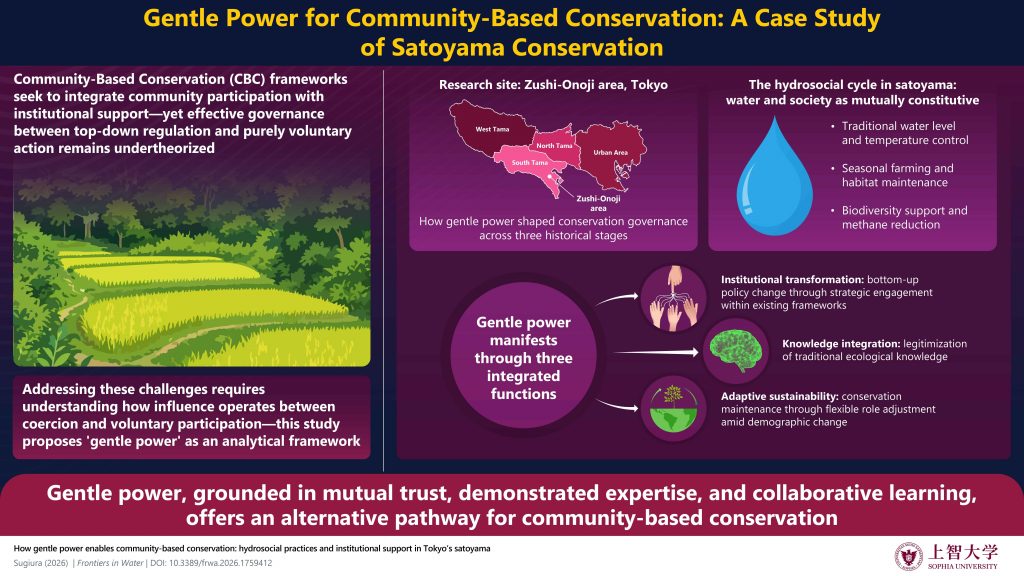



Forty years of Japan’s traditional human–nature landscape conservation demonstrates that expertise and collaborative learning underpin effective conservation governance
As environmental challenges continue to grow, effective and sustainable management increasingly depends on balancing institutional support with community-led action.
Based on four decades of conservation in Tokyo’s Zushi-Onoji satoyama, a recent study conducted at Sophia University, Japan, identifies “gentle power” as a framework grounded in mutual trust, demonstrated expertise, and collaborative learning—offering a new pathway for sustainable environmental governance.
Environmental conservation is one of the most pressing debates across the world. For decades, it has often been viewed as a choice between strict government regulation and voluntary community action. However, a new research study on the conservation of Tokyo’s Zushi-Onoji satoyama introduces a more effective approach that combines both.
Professor Mikiko Sugiura from the Graduate School of Global Studies/Center for Global Education and Discovery, Sophia University, Japan, introduces the concept of “gentle power,” a new framework that explains how ecosystems can be protected through trust, collaboration, and shared expertise rather than only rules and regulations.
The concept emerges from a 40-year case study of satoyama conservation in Tokyo’s Zushi-Onoji area, where local farmers, government agencies, and citizen volunteers have worked together to sustain wetlands, rice paddies, forests, and endangered wildlife. The findings of the study were published in Volume 8 of the journal Frontiers in Water on March 4, 2026.
The research focuses on the traditional Japanese satoyama landscape, a mosaic of forests, wetlands, and rice paddies shaped by generations of human involvement. These landscapes are ecologically significant because they support rich biodiversity while also maintaining water cycles and agricultural productivity (also called the hydrosocial cycle).
Prof. Sugiura explains, “Interestingly, biodiversity in satoyama is not sustained by untouched nature, but by the enduring relationship between people and the landscape.”
By combining document analysis and participant observation spanning from 2022 to 2025, Prof. Sugiura examined how the Zushi-Onoji Conservation Area evolved over four decades. The study observed changes in governance from early conflict over land restrictions in the late 1970s to a more collaborative system.
Local actors strategically engaged with existing legal frameworks to achieve bottom-up institutional change—securing tax relief measures and proposing a commissioned management system that formally transferred conservation authority from external contractors to the local farmers’ association. This process exemplifies how gentle power functions through collaborative restructuring grounded in the legitimacy of conservation practice, rather than coercion or confrontation.
What emerged was a new understanding of power in conservation. Rather than relying on regulations alone, local expertise became important for ecosystem management. Traditional knowledge of seasonal water control, paddy field temperature regulation, and habitat maintenance contributed by farmers was gradually recognized by authorities as essential scientific and ecological expertise.
This approach led to increased ecological benefits. The area continues to support endangered amphibian species listed in Tokyo’s Red Data Book, including the Tokyo Daruma Frog, Japanese fire-bellied newt, and Tokyo salamander. The study also emphasizes traditional intermittent irrigation practices called Alternate Wetting and Drying (AWD), which may help reduce methane emissions from rice cultivation, linking local conservation to climate mitigation goals.
Prof. Sugiura notes, “What makes gentle power effective is that influence comes not from formal authority, but from proven knowledge, mutual trust, and visible ecological outcomes.”
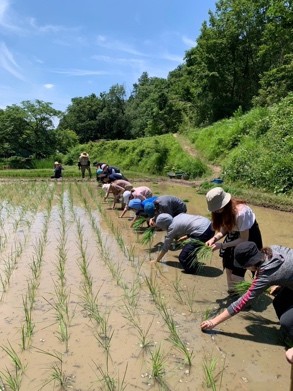
An interesting finding was how this governance model adapted to demographic change. As older farmers aged, their role changed from direct land managers to mentors and instructors.
This is gradually enabling the sharing of expert knowledge with local citizens. Thus, citizen volunteers were gradually united as learners and collaborators, ensuring continuity of conservation efforts. This flexible transfer of knowledge is one of the most important functions of gentle power.
While the study offers promising insights, the author acknowledges its limitations and calls for comparative research across diverse ecological and cultural contexts. But at the same time, it provides practical guidance for local governments and conservation organizations seeking to support community-based environmental management without relying solely on top-down regulation, positioning people as ecological partners rather than threats.
In an era increasingly shaped by climate change, urbanization, and biodiversity loss, the research offers a new way of thinking about conservation through trust-based collaboration and shared responsibility.
Looking ahead, Prof. Sugiura highlights an urgent concern, “As rice paddies and satoyama continue to disappear, the ecological knowledge embedded in human–nature relationships also risks being lost.” By emphasizing the value of local knowledge, seasonal practices, and adaptive learning, the research makes a strong case for nurturing these relationships now as a more resilient model for conservation in the years to come.
Reference
- Title of original paper
How gentle power enables community-based conservation: hydrosocial practices and institutional support in Tokyo’s satoyama
- Journal
Frontiers in Water
- Authors
Mikiko Sugiura1
- Affiliations
1Graduate School of Global Studies/Center for Global Education and Discovery, Sophia University, Japan
About Professor Mikiko Sugiura
Dr. Mikiko Sugiura is a Professor at the Graduate School of Global Studies and is also affiliated with the Center for Global Education and Discovery at Sophia University, Japan. She holds a Bachelor of Laws and a PhD in International Studies from The University of Tokyo, Japan, as well as a BA in Comparative Culture from Sophia University.
Her research interests include sustainable resource management, water governance, agricultural water use, institutional approaches to water rights and commons governance, and human–nature relationships, particularly in satoyama landscapes. Her academic profile includes multiple journal articles, book chapters, and conference papers, focusing on environmental and sustainability studies.
Funding Information
This work was supported by JST/JICA, SATREPS (Grant Number JPMJSA2301, “Securing the Sustainability of Oasis Societies Associated with Water and Land Use in the Western Desert”).
Media Contact
Office of Public Relations, Sophia University
sophiapr-co@sophia.ac.jp