

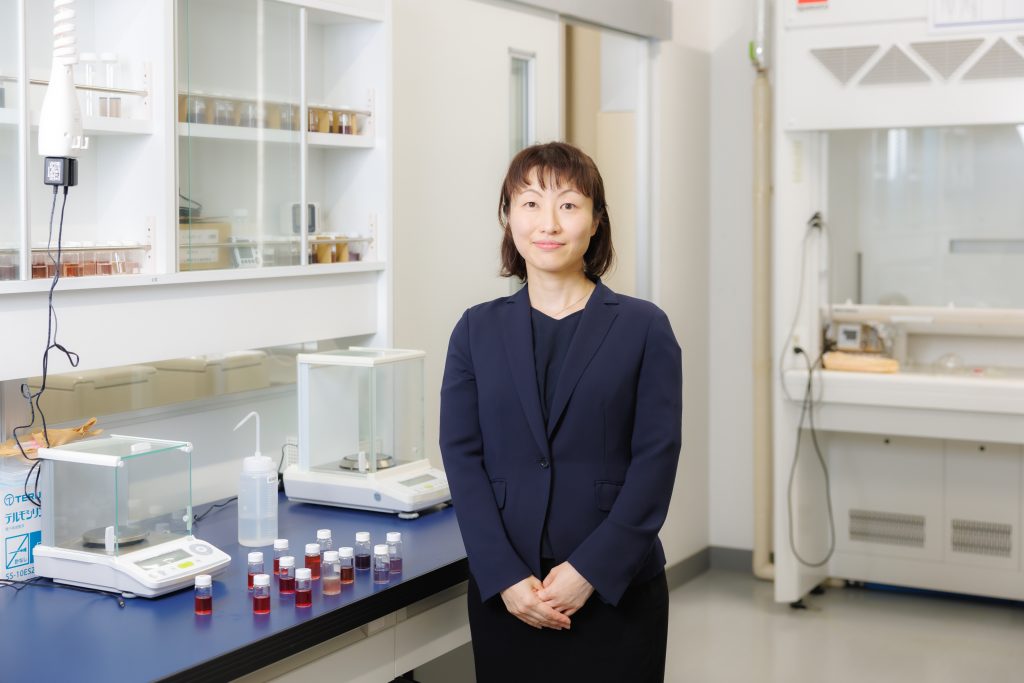
Yukie Yokota
Associate Professor
Department of Materials and Life Sciences
Faculty of Science and Technology



Associate professor Yukie Yokota from the Faculty of Science and Technology aims to develop materials with unprecedented functions using technologies that control noble metals at the nanometer level. She talks about the potential of noble metal nanoparticles, which are expected to have a wide range of applications.
I study noble metal nanoparticles. There is the impression that the noble metal gold is gold in color, and silver is silver in color, but their colors change when you go down to the nanometer (one billionth of a meter) level. For example, gold nanoparticles appear red, while silver nanoparticles look green. Noble metal nanoparticles have been used for a long time, such as gold nanoparticles for the red color of European stained glass and the bronze red of Edo Kiriko cut glass.
However, the world of nanometers is extremely small, measuring one hundred thousandth the thickness of a human hair. For a long time, it was not clear why gold nanoparticles, a familiar material, are red. Advances in semiconductor technology have made it possible to observe noble metal nanoparticles and analyze how they are formed, leading to dramatic progress in nanoparticle research.
Gold nanoparticles are also used in antigen tests

The change in colors when noble metals are turned into nanoparticles is also used in everyday life.
For example, gold nanoparticles are used in antigen tests to check whether a person has contracted influenza or COVID-19. In antigen tests, a sample is dropped onto a test kit and if a red line appears, it is considered positive, and that red color comes from gold nanoparticles.
Gold nanoparticles are given the ability to capture viruses. They bind with antigens (proteins specific to viruses) and gather at the indication area where antibodies (proteins that react to viruses) are fixed, causing a red line to appear.
Unfortunately, speed is needed as this antigen test is likely to be negative immediately after a fever develops. Research is underway to give noble metals specific optical functions when turned into nanoparticles, and we are also researching early detection chips using new functions.
Purifying industrial wastewater using noble metal nanoparticle photocatalysts
Currently, I am focusing on research to fabricate photocatalysts using gold nanoparticles. A photocatalyst is a material that promotes chemical reactions using light energy. Many photocatalysts in practical use are made from titanium oxide, but titanium oxide photocatalysts mainly absorb ultraviolet light.
Meanwhile, gold nanoparticles have free electrons on their surfaces that resonate with light of specific wavelengths, causing the absorption and scattering of light energy. It may be possible to cause chemical reactions even with weak light energy—such as visible light, infrared light, or LEDs—by applying this property and using gold nanoparticles as a photocatalyst.
We are in the prototyping stage, conducting experiments where LED light is used to decompose colored water—such as industrial wastewater—and turn it colorless in the presence of gold nanoparticles.
If water can be purified using this method, it would be much easier to work inside industrial plants compared to using ultraviolet light. As the catalyst itself does not change, there is also the advantage that it can be recovered after use and recycled again and again.
There are two methods for fabricating nanoparticles: the top-down method, which involves etching the surface of the noble metal, and the bottom-up method, which reduces precious metal ions to bond metal atoms. I use the bottom-up method to chemically synthesize nanoparticles.
I enjoy doing experiments with my hands, and every day is a cycle of trial and error. The appeal of research is that new possibilities emerge even if the results are different from expectations. My goal is to achieve water purification using noble metal nanoparticle photocatalysts. In the future, I hope to contribute to medical care with microanalysis technology using noble metal nanoparticles, such as blood analysis for people suffering from the side effects of medication.
The book I recommend
“Gin no Umi Kin no Daichi”(Sea of Silver Sea, Land of Gold)
by Saeko Himuro, Shueisha Orange Bunko

I loved reading this fantasy novel in junior high and high school. Coming from a rural area, I was frustrated by how girls were often held back when they tried to spread their wings. Seeing the female protagonist overcome difficulties gave me the courage to follow my own path. This book encouraged me to pursue the academic subjects I loved.
-
Yukie Yokota
- Associate Professor
Department of Materials and Life Sciences
Faculty of Science and Technology
- Associate Professor
-
Graduated from the Department of Pharmaceutical Chemistry, Faculty of Pharmaceutical Sciences, Tokushima University, and received her Ph.D. in Information Science after completing the doctoral program at the Graduate School of Information Science and Technology, Hokkaido University. Took on several positions—such as research fellow (DC2 and PD) of Japan Society for the Promotion of Science, special postdoctoral researcher at RIKEN, assistant professor at the Department of Chemistry, Faculty of Science Division I, Tokyo University of Science, and assistant professor at the Faculty of Science and Technology, Sophia University—before assuming her current position in 2025.
- Department of Materials and Life Sciences
Interviewed: June 2025