
Reexamining What Makes Sophia, Sophia -A new model for global engagement and deeper learning –
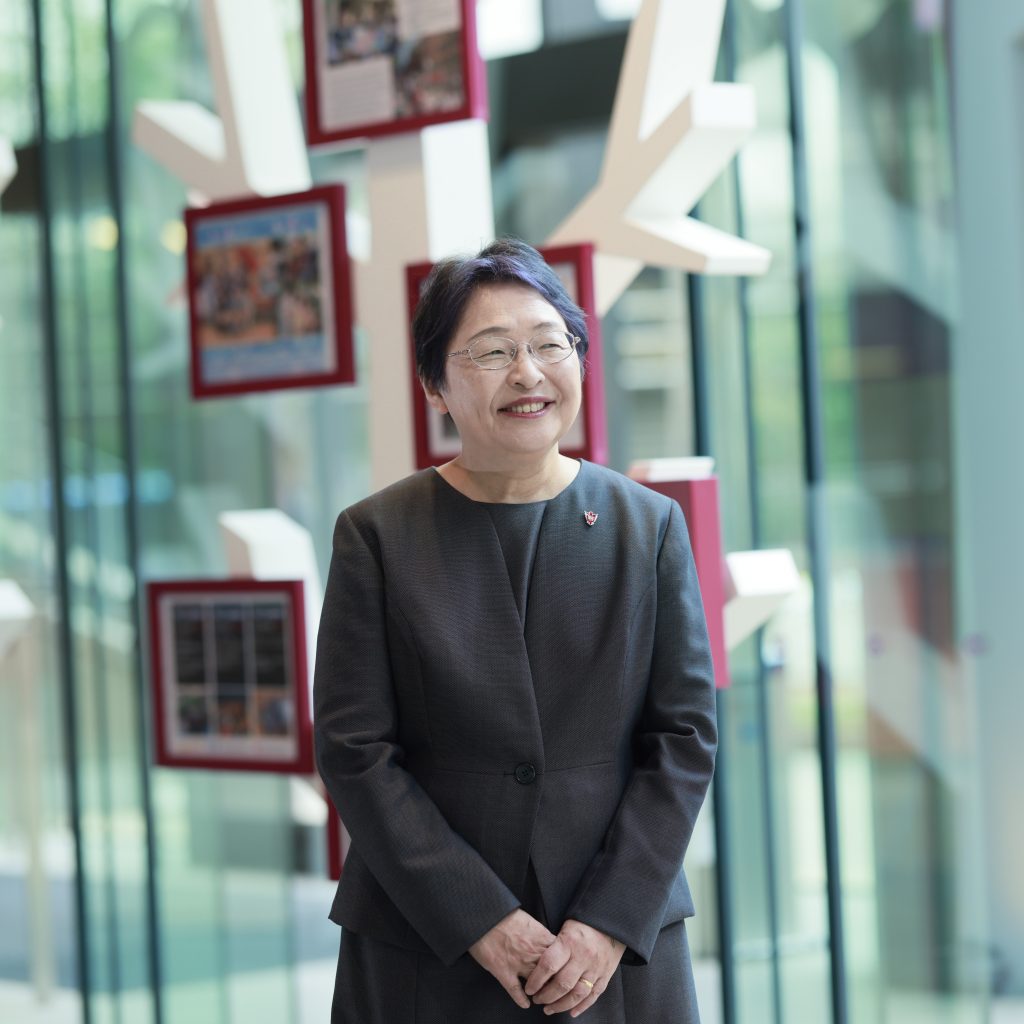
President of Sophia University
Professor, Department of Education, Faculty of Human Sciences
Miki Sugimura



Now entering her second year as President of Sophia University, Miki Sugimura believes that further strengthening what makes Sophia distinctive begins with two key priorities: a new vision for global engagement and fostering deeper, inter/transdisciplinary learning. Looking back on the initiatives launched during her first year, she shares the direction she hopes the University will take in the years ahead.
Building a Campus and Community where people from more than 90 countries come together
Over the past year, I have embraced the phrase “Changing to Stay True” as a guiding principle. While listening carefully to the voices of our students, faculty, and staff, I have continually reflected on what “Sophia” means. One defining characteristic of Sophia is its diversity, which allows for interaction regardless of religion, language, affiliation, and nationality. Today, students from more than 90 countries and regions study on our campus, and one in every six faculty members holds a nationality other than Japanese. More recently, we have also been working to create an even more inclusive learning environment where everyone feels a sense of belonging.
Since becoming President, I have made a point of spending as much time as possible walking around campus. Whether speaking with faculty members about their latest research, chatting with staff about their work, or having students stop me after club activities to share their experiences, these opportunities to hear directly from members of our community have become one of the greatest joys of my role. We have also launched a series of Brown Bag Lunches, an idea proposed by a faculty member who has extensive international teaching and research experience. Inspired by the informal lunchtime gatherings common in many overseas academic communities, participants bring their own lunch and share ideas in a relaxed setting. Faculty and staff from across the University have embraced the initiative, helping to foster open communication that transcends departmental and organizational boundaries.
From Following to Shaping International Frameworks
While embracing diversity remains fundamental to Sophia’s identity, one of my highest priorities is advancing what I call a new model for global engagement. For many years, internationalization in Japan has largely focused on catching up with frameworks established in Europe and North America. Universities have measured progress by increasing the number of courses taught in English, expanding student mobility, and attracting more international students. These efforts have undoubtedly broadened opportunities, but going forward, I believe we must place greater emphasis on the quality of internationalization.
We value cultivating people who do not simply participate in international institutions and norms, but help create them. Doing this requires much more than English proficiency. It demands the ability to understand perspectives, backgrounds, and aspirations of others, and to think critically and creatively from multiple viewpoints, as well as communicate one’s own ideas with confidence and conviction.
In the graduate seminar that I teach, students come from Luxembourg, Germany, the United States, Brunei, Ukraine, South Korea, Ghana, Tanzania, Azerbaijan, Japan, and many other parts of the world. They engage in thoughtful dialogue while respecting one another’s cultures and perspectives. The classroom becomes a truly international learning environment, where students learn not only from instructors but from one another through intercultural and multilateral discussion. Perhaps one of the most valuable lessons that emerges from an environment like this is the realization that people can collaborate even when they disagree. I believe this shared understanding forms the very foundation of multicultural coexistence.
Education, too, is increasingly shaped by geopolitical realities. At a time when conflict, polarization, and exclusionary attitudes are becoming more visible around the world, choosing to foster multicultural understanding and create genuinely inclusive learning environments is more important than ever. Doing so also requires faculty members to possess strong intercultural competence and the ability to respond thoughtfully to increasingly diverse classrooms. We must remain attentive to each student’s individual circumstances, encourage meaningful dialogue, and create spaces where discussions can unfold constructively and respectfully.
Beginning this academic year, Sophia will launch the Sophia Nihongo (Japanese) Project, an initiative in partnership with local municipalities in Tokyo in which our students will support Japanese-language learning for children with international roots. Building on the experience developed through collaboration between Sophia University Junior College Division in cooperation with Hadano City, Kanagawa Prefecture, we hope to expand this pioneering educational model into a meaningful form of social engagement that benefits the wider community.
Our efforts to cultivate Sophia’s distinctive spirit of nurturing commitment “For others, with others” through the richness of diversity may seem like only a small step when viewed against the scale of Japan or the world. Yet I believe these experiences leave a lasting impression. Years from now, whether our graduates are working in Japan or abroad, I hope they will look back and think, “I did this and that at Sophia.” As they encounter complex global challenges, those memories will encourage them to see such issues not as someone else’s responsibility, but as their own. It is through the accumulation of these individual experiences that meaningful internationalization ultimately takes shape.
Cultivating the Ability to Transcend Traditional Academic Boundaries
Alongside this new model for global engagement, I also hope to further strengthen another defining characteristic of Sophia: deep, inter/transdisciplinary learning. As declining birthrates, aging populations, and the rapid advancement of artificial intelligence reshapes society, discussions about how universities should educate future generations have become increasingly important in Japan. At Sophia, preparing students for this future means equipping them to tackle complex challenges and questions that don’t currently have a single correct answer by drawing on knowledge across both the humanities and the sciences. The question is not whether one studies the humanities or the sciences. Rather, it is how students learn to understand both, integrate insights from multiple disciplines, and ultimately transcend the traditional boundaries between them. This inter/transdisciplinary approach has long been central to what makes Sophia, Sophia.
Our Liberal Education and Learning (Kiban-Kyoiku) serves as the foundation for this approach. Through courses such as Embodied Wisdom and Data Science, all students develop the essential skills and habits of mind needed for lifelong learning, regardless of their major. Additionally, in FY2025, the Sophia Africa–Japan Collaborative and Innovative Futures Program (SAFICs) was selected as part of the Ministry of Education, Culture, Sports, Science and Technology’s Inter-University Exchange Project. This program offers a wide range of inter/transdisciplinary courses spanning fields such as anthropology, sociology, economics, and global environmental studies. Students who complete these structured learning pathways are awarded Open Badges, which are digital credentials recognizing their academic achievements and competencies.
We are also strengthening inter/transdisciplinary research by supporting early-career scholars. Through the Sophia SPRING Project, selected as part of the Japan Science and Technology Agency’s Support for Pioneering Research Initiated by the Next Generation (SPRING) program, we are fostering the next generation of researchers while encouraging collaboration across disciplines. This includes creating cross-disciplinary research communities and expanding networking opportunities through programs that bring early-career researchers together from across the University.
Beyond the classroom, programs like Professional Studies, where industry and the University collaborate on learning opportunities, and the Global Citizenship Program, which welcomes learners ranging from high school students to working professionals, we put the ideals of a liberal arts education into practice together with partners both in and outside of the University. These initiatives provide opportunities to reflect on the kinds of learning that today’s rapidly changing world demands.
Whether through a new model for global engagement or deepening inter/transdisciplinary learning, Sophia University is committed to expanding and deepening the spirit of curiosity that students begin cultivating before they arrive at university. We want to fully support every prospective student considering Sophia, as well as every student already studying here. To achieve this, Sophia must collaborate in shaping the next generation of education with our faculty and staff, our students, and high school students and educators.