

Older in Japan: Gender and Living Arrangements Linked to Mental Health


Longitudinal study reveals gender differences in expected years lived with depression across household types
Despite Japan’s rapidly aging population and changing household structures, the relationship between living arrangements and mental health in later life remains unclear.
Researchers have analyzed ten years of longitudinal data to estimate length and proportions of remaining life spent with and without depression among older adults in Japan.
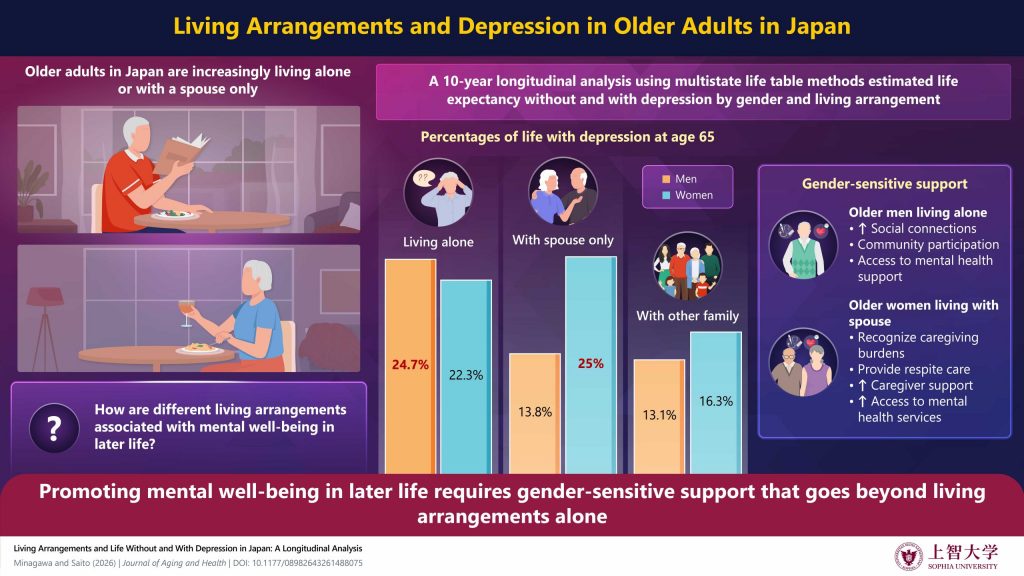
The findings revealed gender differences: men living alone and women living only with their spouses were expected to spend greatest proportions of their remaining lives with depression.
As traditional multigenerational households have become less common, increasing numbers of older adults are living alone or with only their spouses. Over the last few decades, Japan has been experiencing two major demographic changes: a rapidly aging population and a shift in how older adults live. These changes have important implications for health and well-being in later life, as living arrangements can shape social support, companionship, and caregiving responsibilities.
Living alone is often associated with social isolation and depression. However, the mental health implications of other living arrangements remain to be explored. Living with family members may offer companionship and support, but it may also come with the burden of caregiving responsibilities. At the same time, these experiences may differ between men and women. How are living arrangements associated with the number of remaining years older adults can expect to live with and without depression?
To address this question, Associate Professor Yuka Minagawa, Faculty of Liberal Arts, Sophia University, Japan, and Professor Yasuhiko Saito, College of Economics, Nihon University, Japan, examined the relationship between living arrangements of older adults and their association with depression, published in the Journal of Aging and Health on September 09, 2026.
Dr. Minagawa explains, “Living arrangements among older adults in Japan have changed substantially over the past few decades, with declining percentages of intergenerational co-residence and increasing numbers of older adults living alone or with their spouse only.” While previous research has focused on health risks associated with living alone, less is known about how other household arrangements shape older people’s mental well-being.
Drawing on ten years of data collected between 1999 and 2009 from the Nihon University Japanese Longitudinal Study of Aging (NUJLSOA), the researchers used a statistical method known as multistate life table analysis and estimated the expected number and proportion of remaining years spent with and without depression among adults aged 65 and older. They compared three living arrangements—living alone, living only with a spouse, and living with other family members—and examined differences between men and women.
The findings revealed distinct gender differences. At age 65, men living alone were expected to spend 24.7% of their remaining lives with depression, compared with 13.1% among men living with other family members. Among women, the greatest proportion was observed among those living only with a spouse, at 25.0%. By comparison, women living with other family members were expected to spend 16.3% of their remaining lives with depression. These estimates highlight that living alone is not the only arrangement associated with less favorable depression-related outcomes in later life.
The study findings have implications for policies and support programs aimed at promoting mental well-being among older adults. While social connection and access to mental health services may be particularly important for men living alone, support should also address the needs of women living with their spouses. One possible consideration is the burden of family caregiving, which may affect women’s well-being.
“Our study highlights the importance of gender-sensitive approaches to promoting mental well-being in later life. Living alone is often associated with social isolation and poor mental health, but living with a spouse may also be detrimental, especially among women. This point suggests how women shoulder the burden of family caregiving at advanced ages at the expense of their own well-being. Support programs should therefore extend beyond older adults living alone to include those in other living arrangements, with particular attention to gender differences,” explains Dr. Minagawa.
In the longer term, recognizing that mental health risks vary by gender and living arrangement could help policymakers develop more targeted, gender-sensitive interventions. Promoting mental well-being in later life requires ensuring that support reflects the different circumstances in which they age.
Reference
- Title of original paper
Living Arrangements and Life Without and With Depression in Japan: A Longitudinal Analysis
- Journal
Journal of Aging and Health
- Authors
Yuka Minagawa1 and Yasuhiko Saito2
- Affiliations
1Faculty of Liberal Arts, Sophia University, Japan
2College of Economics, Nihon University, Japan
About Associate Professor Yuka Minagawa
Dr. Yuka Minagawa is an Associate Professor in the Faculty of Liberal Arts at Sophia University, Japan. With a Master’s degree from Harvard University and PhD in Sociology from the University of Texas at Austin in 2013, Dr. Yuka Minagawa’s research focuses on social demography, health and aging, and the relationship between social environments and physical and mental health.
Her research investigates health inequalities and health expectancy in Japan and Eastern Europe, particularly the former Soviet Union. Her work aims to understand how social circumstances shape health and well-being across populations.
Funding information
This work was supported by the Japan Society for the Promotion of Sciences [Grant-in-Aid for Scientific Research (25K05518)].
Media Contact
Office of Public Relations, Sophia University (sophiapr-co@sophia.ac.jp)


