

Life doesn’t have to follow a straight path. I want to find my own way forward.
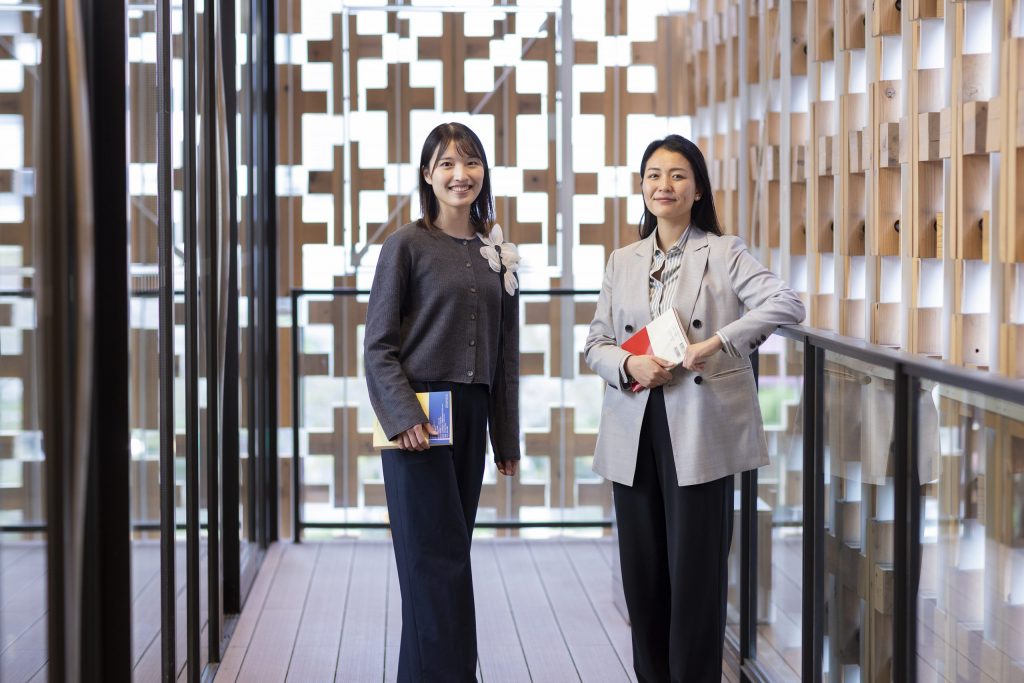
Kie Yoshitake
Senior Associate, PwC Consulting
M.A. in Global Studies (Area Studies), 2018
Kokoro Yasunaga
First-year student, Department of English Studies, Faculty of Foreign Languages


In June 2025, alumna Kie Yoshitake spoke at a seminar titled “Career Development for Female Students and Graduate School Advancement,” held at Sophia University. Kokoro Yasunaga took part that day as a student staff member at the venue. Brought together by chance, the two sat down to talk about how to find a career path that feels true to who you are.
“I was nervous about studying abroad, but I really wanted to give it a try. (Kokoro)”
Kokoro: I was deeply inspired by your talk at the seminar, so I’m happy to be able to speak with you directly today.
Kie: Since the seminar focused on career development and graduate school as an option for female students, I spoke about why I decided to pursue a master’s degree in the humanities and how that choice shaped my career. You’re in the Faculty of Foreign Languages, right? Have your international experiences also become a guiding influence in thinking about your future?
Kokoro: Yes. I spent nine years in international schools during elementary and middle school, so I grew up in an environment where international cooperation and cross-cultural exchange felt very close to me. I went to a public high school, and it felt completely different from the environment I had known. The culture shock was intense, and there was a period when I cried almost every day. That experience made me realize again that I wanted to be in a more international environment, so I studied abroad in the U.S. for one year while in high school.
Kie: Spending a year abroad while still in high school must have been pretty nerve‑racking.
Kokoro: It definitely wasn’t an easy decision. I was worried about my English skills, and was also anxious about what would come after I returned to Japan. In the end, though, wanting to go mattered more, so I gathered the courage to take the step.
Kie: That took a lot of courage. I studied abroad in Spain during my undergraduate days. I was drawn by the culture, but it was my first time truly living as a foreigner. Experiencing what it felt like to be an outsider was a fresh shock for me. As I started thinking about how societies might change as more people move across borders, I became interested in migration. Over time, my interest in international relations and social engagement deepened, and I naturally began to think about pursuing research.
Kokoro: At first, I had a very different career path in mind. From middle school, I aimed for medical school and focused on that goal throughout high school. When that path didn’t work out right after graduation, I took time to prepare again. During that time, I was largely removed from international exchange, which made me realize how essential it had been for me. That experience brought me back to what I feel matters most: working with people and connecting with the world through English.
Kie: I went to an all‑girls school from junior high through high school, and often questioned the very uniform image of how women were expected to live there. Little by little, I learned to define my own way of living instead. Listening to you, it feels like you started facing what you truly wanted at a relatively early stage.
Kokoro: Maybe my high school study‑abroad experience helped me build a kind of resilience. Because my graduation was delayed, I made new friends who were a year younger and came to realize that being different from everyone else isn’t always a bad thing. I stopped worrying so much about age, and began to feel it was okay to move forward at my own pace.
Kie: I see. I hear a lot of similarities with myself—your international interests, your willingness to take on challenges—but honestly, you seem much more mature than I was at your age!

“Graduate school is the ultimate opportunity to pursue what truly interests you. (Kie)”
Kokoro: Something I’ve been feeling again lately is that you don’t have to move ahead in a straight line. I’ve taken a few detours, but because of that, I was able to choose the path I’m on now. Looking back, none of it feels wasted.
Kie: I definitely relate to that. I didn’t start preparing for a job early on in college, but instead kept working on things I liked. Connections naturally formed, and those eventually led to my career—rather indirectly. Because of that, I feel I’ve arrived where I am today on my own terms. For me, graduate school wasn’t just an extension of what came before. Rather, it was a place to explore what I truly wanted to pursue. Only when questions began to form inside me did moving forward start to make sense. I became interested in how migrant communities between the United States and Mexico have changed over time, and studied at a graduate school in Mexico to research that topic.
Kokoro: Until I heard your talk at the seminar, I hadn’t even considered graduate school as an option. Especially in the humanities, there’s no one around me who has gone on to a master’s program.
Kie: What matters most is the process of finding your own answer, rather than following someone else’s path. In my case, instead of following the typical job‑hunting route, graduate school became that answer. After completing graduate school, I worked for two years as a research specialist at a Japanese overseas mission, based at the Embassy in Panama. After that, I spent time at the research arm of a major Japanese trading company, and now work at a consulting firm. Throughout, I’ve consistently been analyzing developments in Latin America. At first, I couldn’t picture myself working at a for-profit company, but later moved from the public sector to the private sector because I began to wonder whether changing how money flows might be another way to influence society. That’s how I hope to contribute from where I am now.
Kokoro: I feel like I’m still at the doorstep of thinking about where to take my career. For now, I want to make the most of the opportunities available on campus, including my involvement in the Exchange Student Supporter Program. I’m also planning to join a Cabinet Office program called “Ship for World Youth,” and am excited about meeting many new people and broadening my perspective even further.
Kie: That’s a great initiative. I’ve personally been supported by many encounters along the way. You’re probably already doing this, but by continuing to share what you care about, people around you begin to understand what you’re interested in. That can eventually lead to connections and opportunities that shape your career.
Kokoro: To avoid future regrets, I’ve always tried to approach each thing with full commitment. No matter the outcome, I think the desire to live in a way I can accept is at the core of who I am. If graduate school enables me to fully explore my interests, then I’ve come to feel it could be an option for me.
Kie: In an era shaped by AI, I believe how you think will become more important than ever. And more than ever before, what matters is not simply having access to information, but knowing how to interpret it and think critically about it. That’s why I believe a master’s program can be one valuable way to sharpen those skills.
※Please note that the information in this article is current as of October 2025.


