
Department of Journalism (SPSF)
Educational Policy
Journalism is an interdisciplinary major focusing on the social roles, functions, and influences of all aspects of journalism and media communication, investigating a broad range of issues in news reporting and media. This is a course steeped in history, as in 1932 Sophia University established Japan’s first ever journalism school.
In the Sustainable Futures program, special emphasis is placed on issues related to sustainable futures. The realization of sustainable futures depends on the effective and ethical participation of journalists, content creators, and media outlets from around the world. This program aims to develop students’ knowledge, skills, and abilities related to journalism and mass communication vital to the realization of sustainable futures.
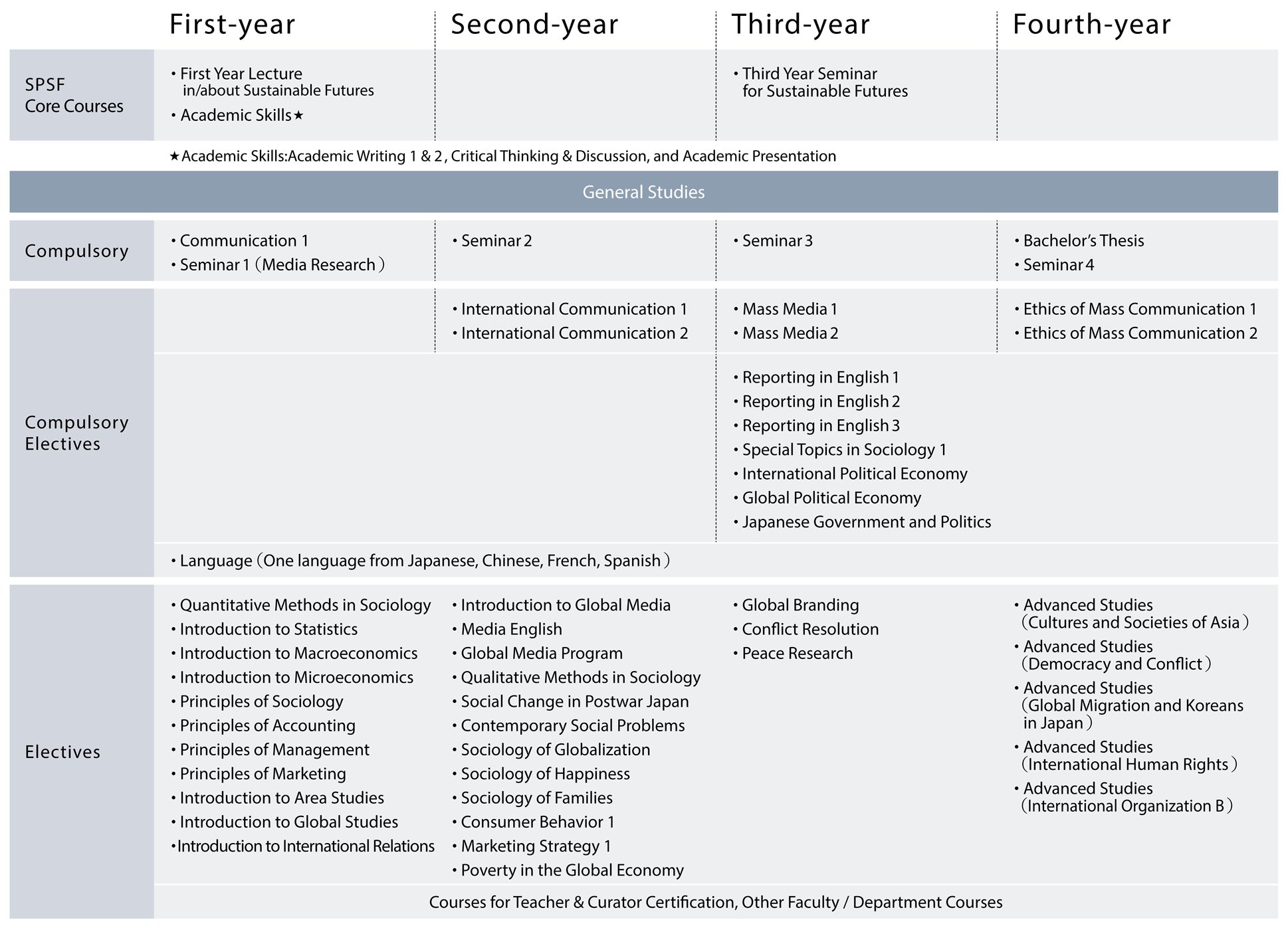
First-year students will acquire fundamental theories of communication and academic research techniques. Starting from the second year, students will take advanced classes on journalism, mass communication, international communication, and ethics. Moreover, from the second to fourth year, students will take seminar classes that nurture critical perspectives, research, and analytical skills related to sustainable futures. In the final year, they will complete their studies by composing a graduation thesis. We look forward to meeting students interested in understanding and discussing sustainable futures through journalism and media communications.
Educational Objectives and Policies
-
To study the social roles, functions and influences of all aspects of journalism and media communication, and investigate a broad range of problems in news reporting and media.
-
To produce graduates well-versed in the types of communication required of a fully-fledged member of society, with advanced communicative skills and media literacy.
-
The Department of Journalism sets standards for the skills and knowledge students should acquire before graduation as follows. Those who fulfill the graduation requirements shall be deemed to have acquired these qualities and will be awarded a diploma.
1. Accumulation of academic knowledge of the various disciplines of journalism, media communications, information, etc. and the practical skills to engage in research, analysis, critical thinking, structuring and presentation based on such knowledge.
2. The ability to learn from both dimensions of “theory and practice and to be a leading player in journalism or other fields that deal with media communications and information
3. High-level communication skills and media literacy to live the informatizing modern worldIn addition to the above, the SPSF course sets the following abilities which students should acquire before graduation as common requirements across its six departments (Department of Journalism, Department of Education, Department of Sociology, Department of Economics, Department of Management, Department of Global Studies).
4. The ability to learn the basic knowledge on “Sustainable Futures,” to understand its importance, and to take action towards resolving challenges to the sustainable futures by drawing upon their academic discipline as well as from the other five disciplines in the SPSF course they learn.
5. The ability to understand and apply the interdisciplinary perspectives and methodologies, learned in their academic discipline and in the other five disciplines of the SPSF course, when addressing issues and presenting their ideas.
-
In accordance with the Diploma Policy, the Department of Journalism constructs its curriculum with courses aligned to the following purposes:
1. To have students study the fields of journalism, media communication and information taking a theoretical approach, media-specific approach, international approach, and realistic problem analysis approach.
2. To achieve a “broad education that is biased to neither theory nor practice” by balancing the abovementioned curriculum with a practical approach aimed at improving such expressive skills, verification skills and critical skills
3. To nurture critical perspectives, research and analytical skills, and ethics in small-group education, by enrolling all students in individual seminars taught by full-time faculty members.
4. To require students to compile a thesis under the individual guidance of a full-time faculty member as a culmination of the knowledge, analytical skills and other skills acquired during the four years of enrollment.In addition to the above, the SPSF course constructs its curriculum in the following manner, for the purpose of achieving the common diploma policy across the six departments:
5. To enable the students during the first year to acquire a basic knowledge on “Sustainable Futures” and the relating issues through the SPSF General Studies Courses, drawing on the perspectives of six disciplines. Based on the acquired knowledge, the students will be able to deepen their understanding in various challenges related to the sustainable futures through Elective Courses in the University-wide General Studies Courses, and they will be also able to learn about the approaches, contents, and methodologies of the different disciplines through Specialized Courses offered by each department.
6. To enable students to gradually gain knowledge of the different disciplines of each Department and also acquire a wide range of knowledge through the courses offered by other faculties and departments which have been designated to offer Elective Compulsory Courses or Elective Courses. Thus, the students will be able to acquire the various perspectives, contents, and methodologies, as well as comprehensive approaches from the courses.
-
The Department of Journalism welcomes students with the qualities described below:
1. Students proactively interested in the disciplines of journalism and media communications in the information-oriented modern world and motivated to study and contemplate the disciplines in depth
2. Students with an inquisitive attitude towards issues challenging modern society as well as the logical thought and judgment required to critically verify such issues
3. Students with the competence to present the survey and research outcomes based on their own interests and the articulateness to explain them
Faculty Members
Ruri ABE Professor

Tomoki KUNIEDA Associate Professor
| Related Articles |
|---|
Arun Prakash D SOUZA Assistant Professor