


Nancy Eunice Alas Moreno
Associate Professor
Department of Hispanic Studies
Faculty of Foreign Studies



Associate Professor Nancy Alas Moreno of the Department of Hispanic Studies specializes in Latin American law, focusing on three main research topics––taxation, arbitration and constitutional law. She wishes to introduce Japanese law in Spanish to Latin American audiences. Also, as a researcher, she feels responsible in the age of AI to maintain integrity of knowledge for researchers.
My main research areas are tax law, arbitration law, and constitutional law in Latin America. Recently, I have been working on papers related to arbitration law in Argentina and on political developments in El Salvador from a constitutional perspective.
There are many similarities between the legal systems in Japan and Latin America. Latin American countries adopt the civil law system, which originated from the Roman Empire and was introduced through Spanish colonization. In contrast, the United States follows the common law system, inherited from England.
In a civil law system, legal decisions are primarily based on written statutes and codes. However, in a common law system, courts refer first to previous decisions by judges before consulting statutory law. Because Japan studied laws in European countries including France and Germany when building its legal system during the Meiji Restoration, Japan also follows a civil law system. This results in considerable structural and philosophical similarities between Japanese and Latin American law.
My interest in Japan stems from my childhood when I was practicing Karate in my home country, El Salvador. It prompted me to study Japanese, which I learned from JICA (Japan International Cooperation Agency) volunteers. I continued my Japanese studies while pursuing a bachelor’s degree in law at university.
Later, I came to Japan to pursue a Master’s and PhD in public law, which required me to further improve my Japanese proficiency. Eventually, I wrote my PhD dissertation in Japanese on a comparative study of taxation laws in Latin America, Europe, and the United States.
As a teacher, I have chosen to specialize in Latin American law rather than Japanese law. This decision stems from the unique strengths I offer within the Japanese academic environment––my Spanish language skills and connection to Latin America. These assets allow me to understand commonalities in the law between the two regions.
I use a wide range of media sources including television, newspapers, podcasts, and magazines from Europe, Latin America and the United States to explore topics that interest me. When a subject sparks my curiosity, I dive deeper by reviewing academic papers, books, and AI tools to assess its viability as a research topic. Afterward, I formulate a research question and begin writing. This is how my research process typically begins.
For example, in El Salvador, there has been a debate about presidential re-election. Prior to its reform, Article 152 (1) of the Salvadoran Constitution contained ambiguous language regarding whether a president may serve a second consecutive term. I approached the topic from a historical perspective, analyzing decisions made by the Constitutional Chamber of the Supreme Court.
Based on my findings, I concluded that the president is not constitutionally permitted to run for immediate re-election. However, in reality, the president was re-elected in El Salvador in 2024, and in July 2025, the Salvadoran Constitution was amended to legitimize the re-election. My research has helped to shed light on the implications of constitutional interpretation and political power in a fragile democracy.
Researchers as Knowledge Creators in the Age of AI

I believe researchers bear a significant responsibility as creators of knowledge. That is one of the key differences between AI and human researchers. While AI can only process and reorganize existing data, researchers create new knowledge, ideas and perspectives. Although my contribution may be small –just a grain of sand in the desert – I believe my research has certain intrinsic value, as all researchers must uphold the integrity of knowledge. AI cannot create new knowledge, but only reorganize information.
Currently many Latin American countries are experiencing political instability. Under such environments, constitutional systems are often the first to suffer as political leaders come to view constitutions as constraints to their authority instead of respecting them.
I believe my research offers value to those trying to understand Latin American political trends. For example, my work on El Salvador’s constitutional changes and their political context is highly relevant not only to my own country, but to other countries that may follow similar paths. I aim to show how political leaders who disregard constitutional limits can gradually transform democratic systems into authoritarian regimes. From a legal standpoint, I hope my work contributes to a broader understanding of how fragile a constitutional democracy can be, and how essential it is to protect it.
My Goal: To Introduce Japanese Law to Latin America in Spanish
Looking ahead, I plan to conduct comparative analysis of laws between Japan and Latin America, and present Japanese law to Latin American audiences in Spanish. Currently, most literature on Japanese law available in Latin America is written in English, which limits its accessibility to Spanish speakers. One of my goals is to translate papers written by my Japanese thesis advisor–especially those related to taxation law–into Spanish.
While both Japan and Latin America share some fundamental tax principles, such as “no taxation without representation,” there are also some significant differences. For example, Japan classifies income into ten categories, while in many Latin American countries, income is treated as a single category.
There is a wealth of high-quality research being conducted in Japan in this field. Making Japan’s taxation law accessible to Latin American academics and policymakers in Spanish would greatly benefit ongoing research in the region.
The book I recommend
“Courtroom”
by Quentin Reynolds, Published by Farrar, Straus and Giroux
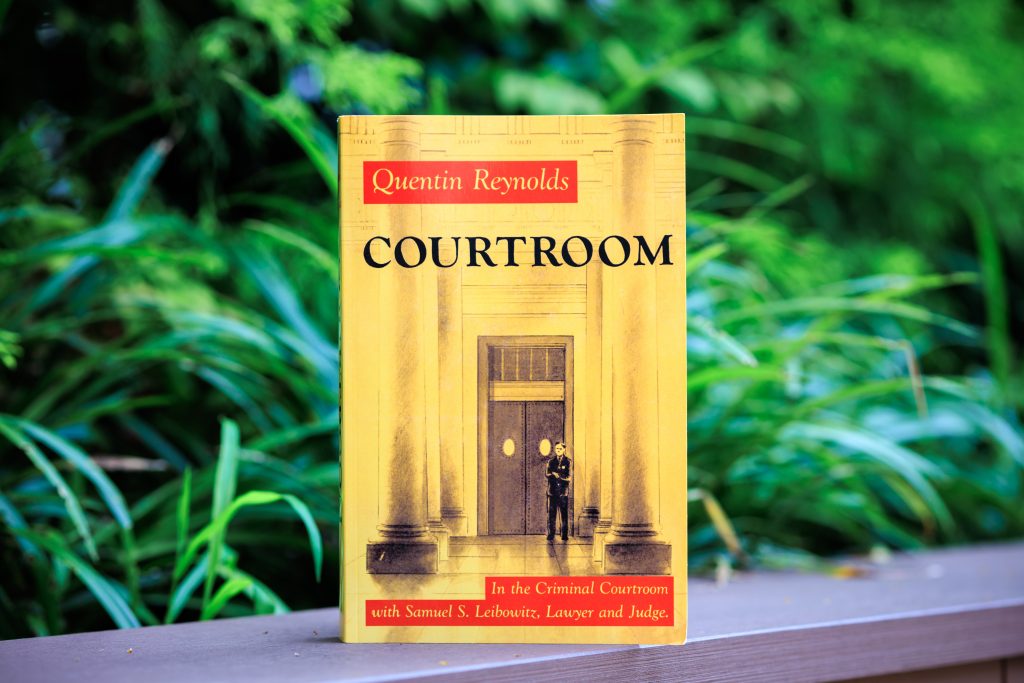
Written by a journalist, it is the story of renowned lawyer Samuel Leibowitz, who defended challenging and unwanted cases such as defending African Americans when it was considered taboo. Motivated by a strong belief in justice, he used creativity to win these cases. The book taught me the importance of creativity in the field of law. The story is also a valuable resource for learning legal terminology and the American legal system.
-
Nancy Eunice Alas Moreno
- Associate Professor
Department of Hispanic Studies
Faculty of Foreign Studies
- Associate Professor
-
Nancy Eunice Alas Moreno is a Salvadoran lawyer who earned her master’s and PhD in Public Law from Doshisha University. She is also an Associate Professor in the Department of Hispanic Studies and a researcher at the Ibero-America Research Institute of Sophia University.
- Department of Hispanic Studies
Interviewed: June 2025